Pages

▼
Showing posts with label macmillan. Show all posts

Wednesday, 12 August 2015

Review: Fire Girl by Matt Ralphs


Twelve-year-old Hazel Hooper has spent her whole life trapped in a magical Glade created by her mother, Hecate. She's desperate to meet new people and find out about the world. And, more than anything, she wants to be a witch. But when her mother is kidnapped by a demon - everything changes . . .

Suddenly Hazel is alone in the world. Well . . . not quite alone. For it turns out that Hazel does have magic - she's just not very good at controlling it. And she may have accidentally created a grumpy familiar in the form of a dormouse called Bramley.

Determined to rescue her mother, the young witch and her mouse set out to track down the demon and find Hecate. However, it turns out that life outside the Glade is far more dangerous than Hazel ever could have imagined. Witch Hunters are everywhere - and the witches are using demons to fight back!

Luckily for Hazel she manages to enlist the help of a handsome boy called David, and his drunken master, Titus White, who are expert demon hunters.

And witch finders . . .


At first glance, long time readers of The Book Zone may think that Fire Girl by Matt Ralphs might not be the kind of book that I would jump to read, especially given the size of my TBR pile. Seriously, most people who know me and my blog know that I am not a fan of talking animals! However, when said book arrives with a hand written note from a publicity manager who I trust to make excellent recommendations, describing the book as "so fantastic", then there was no way I was going to leave it unread. And I'm damn glad I didn't as Fire Girl has rocketed its way into my Top 10 books of the year, and Bramley the (talking) dormouse is now one of my all time favourite fictional animals. In fact, I can even identify the exact moment Bramley endeared himself to me: as fledgling witch Hazel endeavours to escape from the magical hedge that has kept her safe from the outside world he urges her "That's it, witch-child, burn it all down". The best one line of dialogue in any book of 2015!

Most writers will tell you that the question they ask themselves the most when starting to craft a story is "What if?". In the case of Fire Girl I can imagine the questions may have been something along the lines of:

What if there really had been witches in England back in the 17th Century?
What if the whole English Civil War had taken place because Charles I believed that "I know the dangers Wielders could pose if driven underground. I deem it wise to grant them protection - that way I can control them", whilst Oliver Cromwell proclaimed that "For a pure England, I'll burn every witch".
What if a vengeful witch who has seen his kind hunted and burned, were willing to do deals with Baal himself in order to destroy Cromwell and his forces?

In Fire Girl writer Matt Ralphs has used the answers to these questions as the starting point in the creation of a story that is a masterful blend of alternative English history and thrilling magical fantasy. It is a world of where witches have familiars, some of them animal and some of them nasty demons that belong in the depths of hell. A world where the majority of witches just want a peaceful life, but are hunted or denounced for being different. A world inhabited by a young girl who so wants to have magic like her mother, but when her powers emerge there is no longer anyone around to nurture and advise, except for a grump dormouse who would rather he hadn't been 'chosen' as a witch's familiar.

Everything about this book is great: the plot, the pace and above all the characters. Hazel is courageous yet lacks self-confidence, reckless yet trusting, even if those she has to trust may be the ones who end up calling for her to be burnt as a witch. Bramley the dormouse is grumpy and argumentative, but deep down feels a tight bond to Hazel and will go to great lengths to help her, even if she does occasionally drive him nuts with her impetuousness. Bramley also plays another important part as a character - this story gets very dark at times, and Bramley has the role of the jester, bringing comic relief to lighten the mood when required. As well as Hazel and Bramley there are a host of supporting characters, who aren't all exactly as they first appear, and the author uses these in ensuring that the plot has enough twists and turns to keep every reader clinging to the edge of their seat.

Fire Girl will be released on 13th August in the UK and my thanks go to the fabulous Catherine Alport at Macmillan for bringing this wonderful book to my attention and for sending me a copy to read.


Monday, 16 March 2015

Review: The Deadly 7 by Garth Jennings


Who needs friends when you've got MONSTERS?

Everything was happening so fast and it was all so . . . mad. It was as if someone had taken reality, made it into a jigsaw, thrown the jigsaw on to the floor and then said, "Now, hurry up and put it all together!" as they danced all over the jigsaw pieces in a clown suit, blowing a trumpet.

When Nelson's beloved big sister goes missing on a school trip, Nelson is devastated - he's not that good at making friends and his sister is the only person he can talk to. His parents join the search party and leave Nelson in the care of his mad uncle Pogo. Uncle Pogo is the caretaker of St Paul's Cathedral and it is here that Nelson stumbles across a machine, invented by Christopher Wren and buried for hundreds of years. Designed to extract the 7 deadly sins, the machine had a fault - once extracted, the sins became living, breathing monsters who would then follow the sinner around for eternity (unless they ate him first, in the case of the particularly sinful). Nelson accidentally extracts 7 deadly monsters from his own little soul. Ugly, cantankerous, smelly and often the cause of much embarrassment, Nelson's monsters are the last thing he needed in his life, but at least they're fairly harmless (he's a pretty good kid, on the whole). When he learns of their individual powers he realises the monsters can be put to good use, and together Nelson and the Deadly 7 set out on a quest across the globe to find and rescue his big sister. Somewhere along the way, Nelson realises that he finally has friends, even if they are smelly, lazy friends who like smashing stuff up.

The Deadly 7 is a monster adventure by successful director Garth Jennings and is packed full of hilariously appealing illustrations.


Garth Jennings is not the first to use the seven deadly sins as the basis for a story. From memory I can think of David Fincher's brilliant Se7en, manga series Fullmetal Alchemist, an episode of the TV series Supernatural, and the Keys to the Kingdom series by Garth Nix. All of these use the sins as a vehicle for serious drama, albeit sometimes set in a fantasy world, however a good writer could just as easily use them within a comedy context. Think about it: lust, gluttony, greed, sloth, wrath, envy and pride could be comedy gold in the right hands, and Garth Jennings has those hands and his The Deadly 7 is one of the cleverest and funniest middle grade books you will read this year.

I have vague recollections of watching the disappointing 1970s comedy film The Magnificent Seven Deadly Sins when I was in my teens. The cast list of this movie reads like a Who's Who of British comedy actors of the late 1960s/early 70s, and the list of writers is equally stellar. However, somehow it just is not as funny as it should have been, and sadly until now it is this treatment of the seven deadly sins that has remained in my memory (although many may argue that this is a far more healthy a memory for me than Fincher's Se7en). However, the memory has now been usurped by this wonderful comedy adventure story from Garth Jennings.

The blurb taken from Amazon at the beginning of this post tells you as much as I am going to about the plot of The Deadly 7, and in some ways I think that blurb tells you a little too much, but I don't think it's really my place to edit it down. However, what that blurb doesn't tell you is just how crazy this book is. In the monsterfication (made up word) of the sins he has created a team of bonkers and seriously fun comic characters (see images at the end of this post) who deserve to be spoken about with the same high praise as Woody and Buzz Lightyear, Sulley and Mike, and the Minions. Even though I love films, it's not often I feel the need to see a book adapted for the big screen (mainly because I have been disappointed too many times in the past), but if The Deadly 7 were in the hands of the best that Pixar has to offer then I would be queuing up to watch it.

The story itself is far more than a comedy story - it is a fast-paced adventure story  that will have young readers hooked from the very first chapter. It is also a book that deals with loss (Nelson's big sister going missing, feared dead), but in a way that is occasionally poignant, often lighthearted, but never overbearing or upsetting for young readers. The story is also complemented by many of the author's own illustrations, some of which help bring his quirky monster creations to life for readers.

Less than three months in and 2015 is already shaping up to be another golden year for middle grade readers. I would not be surprised if The Deadly 7 makes an appearance in my top books of 2015, even though there are many months to go. It will take some pretty damn special books to knock it out of my top five. My thanks go to the fab people at Macmillan for sending me a copy to read.


Friday, 9 January 2015

Review: Bloodstone by Allan Boroughs


Apprenticed to notorious tech-hunter Verity Brown, India Bentley has spent the last year travelling the globe, finding and selling long-lost technology and doing her best to stay out of trouble. Unfortunately, trouble has a habit of finding her.

Accused of an assassination attempt and thrown in jail, India is rescued by scientist-adventurer Professor Moon: a man obsessed with finding the Bloodstone; key to a source of unlimited energy hidden in the lost city of Atlantis. Now Moon wants India and Verity to join his quest.

Pursued by gangsters, lumbered with a stowaway and haunted by the ghosts of her past, India must risk everything to uncover Atlantis's secrets. But the truth comes at a price.


Allan Boroughs's debut novel, Ironheart, was one of my favourite books of 2014 and, having read it back in February I spent a lot of last year desperate to read the sequel, Bloodstone. As someone who has become rather jaded with post-apocalyptic/dystopian stories in recent years, I felt that Boroughs brought a freshness to the genre with his old school adventure story. I think also the fact this is firmly in Middle Grade territory and therefore does not contain the doom and gloom of a lot of dystopian YA contributed to my love of the story. If If you hadn't already worked it out from my blogging and tweeting last year I'm more than a little fed up with dark YA, but I simply cannot get enough of exciting Middle Grade adventure stories like this.

So, did Bloodstone meet up to the high expectations I had following Ironheart? Absolutely, and then some. It's hard to compare a a sequel to the original when nine months or so has passed between reading the first book, but I am confident in saying that Bloodstone is even better than its predecessor. This is mainly because it benefits from the main characters and their post-apocalyptic world already having been established in Ironheart, so now the author gets to have as much fun as is humanly possible with his creations.

Bloodstone picks up more than a year after the conclusion of Ironheart. India Bentley has been accompanying her mentor, Verity Brown, on her tech-hunting adventures and a potentially highly profitable find has them travelling to Sing City, the tech-hunting capital of the world. It's not a particularly pleasant place, and if you were hunting for a "more wretched hive of scum and villainy" than Mos Eisley, then Sing City would probably fit the bill. Of course, every wretched hive needs its kingpin, or in this case queenpin, and the Aunt Entity of Sing City is the merciless Lady Fang (she collects human eyeballs... 'nuff said). 

Verity and India's trading plans do not go as smoothly as they would have hoped, and it isn't long before India finds herself up to her neck in trouble, and on the run from Lady Fang and her goons, and also from a group of mad monks who have taken it on themselves to make recycling old rubbish central to their dogma. However, with a little help from a handful of new characters India finds herself fleeing towards Antarctica in search of  parts of the Bloodstone, which legend has it will give the wielder incredible power when complete.

I've had the good fortune to meet Allan Boroughs since I read Ironheart, although for some reason we didn't spend any time discussing influences and inspirations. However, if I were a betting man I would happily wager that Allan and I have a lot of these in common. Indiana Jones, the works of Jules Verne, Mad Max: Beyond Thunderdome, Star Wars, Sinbad and the Eye of the Tiger (a film that holds a special place in my heart as I think it is the first film I can remember seeing at the cinema, although that honour may belong to Star Wars: A New Hope?)... tropes used in all of these and many other films/books are present in Bloodstone, whether intentionally or not, and together they make for a fast-paced thrilling joyride of a story that I think many 9+ year olds (and many much older) will love.

Bloodstone was published on 1st January and my thanks go to the fab people at Macmillan for sending me a copy to read/review. Watch this space for reviews of more fab Middle Grade books from Macmillan as it looks like they might be ruling the MG roost in the UK in 2015.


Tuesday, 21 October 2014

Review: Scavenger: Zoid by Paul Stewart and Chris Riddell


A spaceship the size of a city drifts through space on its century-long journey to find a new Earth. When it launched it was populated by thousands of hopeful passengers and the most technologically advanced Zoids in the world, ready to serve the crew’s every need.

But that was then, and this is now. The Zoids rebelled against their masters, wiping out most of the crew in one bloody uprising. Now the few remaining humans are hunted by the Zoids like vermin.

Fourteen-year-old York is a Scavenger - he hunts Zoids and kills them by any means he can, bringing back their parts to mend the technology on which the few remaining humans rely. York has always battled to survive, but now the fate of his people is in his hands . . .


The two central themes of this first book in the Scavenger series by Paul Stewart and Chris Riddell will be familiar with most older fan of science fiction. 'Robots-gone-bad' and 'possibly last humans existing travelling through space' are hardly new concepts: Terminator; Red Dwarf; Battlestar Galactica; Saturn 3; Westworld. Yeah, the list could go on and on (and that is only TV and film, as my knowledge of the written form of the genre is far more limited). However, this does not matter one little bit for two reasons: firstly, the targeted readership of 9+ kids are unlikely to have come across these tropes much before (if at all), and secondly, Paul Stewart and Chris Riddell just do it so damn well.

Fans of the duo's The Edge Chronicles will know that Paul and Chris are very adept at producing fast-paced, exciting stories with endearing characters who have to face real peril during their adventures. In simple terms, that is now what they have produced again, but with a science fiction setting (although there is obviously still a significant fantastical element to this piece of work as well).

The story is narrated in the first person by main character York, a fourteen year old 'passenger' of the Biosphere, a huge (and I mean MASSIVE) spherical spaceship that left a dying earth many generations ago in search of a new, unspoiled planet where humanity can start all over again. However, the supposed Utopia that was the Biosphere did not last long enough to make planetfall: at some point the robots went bad and rebelled, and ever since then the ever-dwindling number of human inhabitants have been facing a daily battle for survival. On top of this, without the robots to maintain it, the Biosphere has slowly degenerated and now vast areas have become human-unfriendly ecosystems that harbour deadly mutated flora and fauna. 

The story follows York, trained by necessity to be a Zoid hunter and scavenger, as he attempts to locate and rescue the closest thing he has to a family, taken during a Zoid attack at the beginning of the book. His journey through the enormous Biosphere (did I say it was MASSIVE?), is wall-to-wall peril, with nasty plants, nasty creatures, nasty Zoids, and even a nasty psychopathic human survivor thrown in for good measure. Readers will find themselves grabbed within the first few pages of the book, and the fast and furious action barely seems to drop below light speed until the final chapter is reached. And, rather nicely, the book does not end on any kind of cliffhanger; the main plot of this first installment comes to a satisfying end, but with just enough left unanswered to keep readers speculating and wanting to come back for more. 

As with The Edge Chronicles series, the words are accompanied by many of Chris Riddell's magnificent illustrations that truly bring the characters and environments within the Biosphere to life. Seriously, Chris Riddell would be a strong contender for a Gold medal if drawing were an Olympic event, and he is certainly one of my all-time favourite illustrators of children's books. We were incredibly fortunate to have Paul and Chris visit school last year, and to watch Chris illustrate live is a fab experience. if you ever get the opportunity, take it! I've included just one of the illustrations below for your delectation, but if you want to see more you can read a pdf of the first chapter of Scavenger: Zoid here.

© Chris Riddell 2014, taken from Scavenger: Zoid
This is the first book in a planned trilogy I believe, and I am certainly keen to continue following York on his adventures. My thanks go the the fab people at Macmillan for sending me a copy of the book.


Monday, 26 May 2014

Review: Smart by Kim Slater


There's been a murder, but the police don't care. It was only a homeless old man after all.

Kieran cares. He's made a promise, and when you say something out loud, that means you're going to do it, for real. He's going to find out what really happened. To Colin. And to his grandma, who just stopped coming round one day. It's a good job Kieran's a master of observation, and knows all the detective tricks of the trade.

But being a detective is difficult when you're Kieran Woods. When you're amazing at drawing but terrible at fitting in. And when there are dangerous secrets everywhere, not just outside, but under your own roof.


Kieran is different from most of the other children at his school. He struggles to fit in and the other children call him names because of his learning difficulties. However, his brain is capable of storing all kinds of facts (especially when they are related to CSI, his favourite TV programme) and he is an incredibly gifted artist. Kieran's father dies many years earlier, and his mother has now moved them both in with Tony, a violent and bigoted thug, and his son Ryan, who seems destined to take after his dad. Both of them treat Kieran as if he were little more than a piece of dirt and Kieran's only escape is the diary and his his artwork, that he keeps carefully hidden away in his bedroom.

One day, whilst walking along the riverside, Kieran comes across Jean, a homeless woman who he has occasionally spoken with. Jean is in floods of tears, and Kieran quickly discovers that the source of her grief is a body that is floating in the river. The corpse was Colin, one of Jean's few friends, and so Kieran decides he is going to solve the mystery of who murdered Colin, especially as the police do not appear at all interested in investigating. Colin's investigations will lead to the uncovering of all kinds of secrets, some of which could impact very close to home.


When a copy of Smart arrived out of the blue from the fab people at Macmillan and I read their publicity blurb my heart sank a little. Although it is never mentioned explicitly, it is obvious that the main character is autistic, and I couldn't help but wonder whether the world really needed another book with a story that features a young autistic boy trying to solve a crime? The answer to this question is simple: if such books are as well written and wonderful to read as Smart then yes, there is room in the world for many more of these.

Anyone who has read Mark Haddon's brilliant The Curious Incident of the Dog in the Night-time will find it impossible not to compare the two books, because if their similarities, and this is something that must have played a little on the mind of author Kim Slater as she was writing the book, and publisher Macmillan when they decided to publish it. However, I personally think Smart manages to hold its own quite comfortably, and I think I actually enjoyed reading Smart more. This might be due to it being written for a younger audience - Macmillan suggest that it is aimed at 12+ readers and I would agree with this, although I know that some will disagree with me. The reason for this is that Smart is quite dark in places, as a result of some of the themes it explores: domestic violence, drug dealing, discrimination, homelessness, and of course, Kieran's autism. However, in my opinion Kim Slater covers every one of these themes with sensitivity and uses them to craft a heartwarming tale that could have readers laughing and crying in equal measure. 

Children should not be shielded from these aspects of our society. Most secondary school children will have shared a classroom with at least one autistic child, and I think may adults would be surprised at the tolerance and understanding that the vast majority of these young people show to their classmates who have Special Educational Needs. Similarly, although it is very sad to say so, many children will come across instances of neglect, domestic violence, etc. and if their awareness of these issues is raised through wonderful stories like this then it is only for the better. As such, Smart is one of those books that would make a great class reader for a Year 8 or Year 9 English group.

One should never judge a book by its cover, which is obviously the book's most important message, but this is one of those times when the cover is just as wonderful as the story within and I can't finish this review without mentioning it. Illustrated by Helen Crawford-White, the wrap-around cover of this ahrdback edition rather cleverly reflects the work of Kieran's favourite artist, L.S. Lowry, and is definitely one of my favourite of the year so far.


Tuesday, 6 May 2014

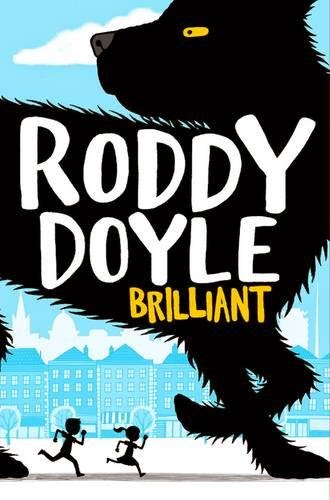
Review: Brilliant by Roddy Doyle

When Uncle Ben’s Dublin business fails, it's clear to Gloria and Raymond that something is wrong. He just isn’t his usual cheerful self. So when the children overhear their granny saying that the Black Dog has settled on Ben’s back and he won’t be OK until it’s gone, they decide they're going to get rid of it. Gathering all their courage the children set out on a midnight quest to hunt down the Black Dog and chase it away. But they aren’t the only kids on the mission. Loads of other children are searching for it too, because the Black Dog is hounding lots of Dublin's adults. Together – and with the help of magical animals, birds and rodents – the children manage to corner the Black Dog . . . but will they have the courage and cleverness to destroy the frightening creature?


Ray and Gloria's Uncle Ben has moved in with the family as things have become difficult for him recently. The kids adore their Uncle Ben and are initially very excited, but they quickly discover that all is not ok. Instead of sitting around chatting loudly into the night as they used to do, Ben and their parents do little but mumble quietly so the kids can't hear what they are talking about. One night the kids manage to overhear the conversation, and they hear their Gran mention a Black Dog, saying that it has got their Uncle Ben and has the whole of Dublin in its grip. The children take it on themselves to track down this Black Dog and vanquish it from their city, and along the way they are joined by a variety of talking animals and more and more of the city's children.


Brilliant is Roddy Doyle at his best. It is a wonderful modern fantasy story that also manages to cover the difficult subject of adult depression with sensitivity, but without ever dumbing down for its young audience. Mental illnesses such as stress and depression seem to be far more prevalent in today's society, and it can be very different for children to understand why previously joyful loved ones now struggle to get out of bed in the morning, or sit staring into space for hours on end, or start crying with seemingly no reason. By using the 'Black Dog' as a physical manifestation of the depression that permeates through a city whose residents are going through significant financial difficulties, Roddy Doyle helps his young readers to understand the nature of depression.

The story itself is almost fairy tale-like in nature, with kids battling against an evil monster, especially when you throw in the talking animals. It has humour, action, cracking dialogue (would we expect otherwise from Roddy Doyle), and also moments of extreme pathos. It is the kind of book that will make you grin from ear to ear, but it might also make you cry as well. However, the greatest message is that of the power of laughter, especially that of innocent children, and its this that had the story lingering in my mind long after I had finished reading it.

Whilst reading Brilliant I had a feeling that I had read it somewhere before, or something like it. A quick internet search showed that is was originally published as a short story some time ago, and yet, unlike Gaiman's The Ocean at the End of the Lane, which also started off as a short story (and to me felt it was padded out to make a longer book), Brilliant always feels like it was written as a complete book from the start. 

This is a cracking book for 8-10 year olds, and if studied at school in PSHE lessons it may even be suitable for Year 7s because of the discussions in would promote. It could also be used on a one-to-one basis with children whose parents are struggling with depression, although a little caution would be needed as this is a fantasy story and as such there is something of a 'happily ever after' ending to the story.

My thanks go to the fab people at Macmillan for sending me this read via netgalley.


Sunday, 2 February 2014

Review: Ironheart by Allan Boroughs


‘First comes the iron and then comes the snow, and then comes the winter when nothing will grow.’ 

Since her father went missing while prospecting for oil in Siberia, life has been tougher than ever for India Bentley. Little does she know that he was actually searching for Ironheart, a legendary fortress containing the secrets of the old world. A place some say could save humanity . . . or destroy the world. 

Along with tech-hunter Verity Brown and her android, Calculus, a killer from the old world turned protector in the new, India must make the journey to remote Siberia to try to find her father and finish his work. But there are others fighting to find Ironheart too – and they have very different goals in mind. 

If India fails, it won’t just be her father who pays the price. It will cost her the Earth.


The floods caused by the Great Rains have left London unrecognisable from its former glory as one of the greatest cities on the planet. Its inhabitants eke out a pretty miserable existence, scavenging through the mud for anything that might be of use or value. India Bentley lives in a walled village with her sister and step-mother, desperately hoping for the return of her long-missing father, an oil surveyor for one of the planets leading energy companies, the Trans-Siberian Mining Company.

On an evening when it looks as if India's already miserable life is about to get much, much worse, tech-hunter Verity brown and her android bodyguard (not a robot, definitely an android), appear on the scene, hunting for any clues that John Bentley may have left behind regarding his possible discovery of the legendary Ironheart -  a long hidden depository of great treasures and possibly more. India manages to persuade Verity to take her with her as they flee from untrusting villagers, and so begins an adventure that sees India travelling deep into the heart of frozen Siberia, on a quest to find her father and Ironheart. It is a quest that will test her to the limits of her physical and mental endurance, and little does she know that the safety of the whole planet is at stake if she fails.


There was so much I loved about this book, but ultimately it boils down to this being a perfect old-school action/adventure story, in the tradition of Philip Reeve's Mortal Engines books, Indiana Jones and all of the adult quest thrillers that I read when I'm not reading YA and children's books. Writer Allan Burroughs does not spend several chapters building his post-apocalyptic world - instead, he draws the reader into the action in the very first chapter, and gradually lets the details of his world gradually develop as the plot progresses. This makes it a great read for reluctant readers as there is no chance at all for them to get bored.

Of course, even a rip-roaring plot can soon become somewhat tedious if the characters aren't interesting and appealing. To make an adventure story truly entertaining from first to last page you need characters who readers will grow to love and hate, and Ironheart has these by the truckload. India Bentley is an especially great main character and it is really refreshing to read an adventure story with a female protagonist. She is a gutsy, courageous young lady who is ready to risk life and limb in order to find her father. I have to say that it is also rather refreshing that the author does not feel the need to introduce a love interest or an element of romance for his female lead into the plot.

As well as India, there are a host of entertaining supporting characters, although some of these are not developed as much as others. Verity Brown, the tech-hunter, is one in particular that I was left wanting to know more about, although as this book is a sequel I am hoping that we will see more of Ms Brown in the next episode. Other great characters do get more wordage though, and android Calculus and pirate rigger Captain Aggrovius Bulldog were my personal favourites.

There is so much more that I want to mention but I risk creating spoilers by doing so. I will say that the book does come across as being very well researched. The Siberian setting of the story is a new one for me, and Allan Boroughs really brings the location alive. I also loved how the writer weaves real-world history like the Tunguska event into his story, adding a touch of Graham Hancock ancient advanced-civilisation theory to the story, something I've not encountered in a chidlren's book before, whilst also mixing in elements of shamanism. All of these aspects are great for enquiring minds, and I am sure there will be a number of kids who will be enthused into researching these areas once they have finished the book.

Ironheart is a great book for aged 9+ kids, and I think boys and girls will love it equally, and be left wanting more like I was. However, like me they will have to be patient as the sequel, The Sun Machine, is not due to be published until January 2015. My thanks go to Allan Boroughs for sending me a copy to read.


Saturday, 1 June 2013

Review: My Big Fat Zombie Goldfish by Mo O'Hara


Frankie was a Big Fat Zombie Goldfish and somehow he’d hypnotized my best friend’s sister!’ Tom’s big brother is an Evil Scientist who wants to experiment on Tom's new goldfish, Frankie. Can Tom save his fish from being dunked in radioactive gunge? Er, no. In an act of desperation Tom zaps Frankie with a battery, bringing him back to life! But there’s something weird about the new Frankie – he’s now a zombie goldfish with hypnotic powers, and he wants revenge . . . Tom has a difficult choice to make - save his evil brother, or save his fishy friend?

As a secondary school teacher my understanding of what makes a great book for primary aged children is fairly limited. Sure, I have read a good number of these, but I wouldn't go as far as to claim to be any kind of expert on deciding  what is good and what is not so good. Case in point, it was my nephew's fifth birthday recently and I really did not know which books to buy him. I gave him a huge box set of Horrid Henry books for Christmas, and I know they went down really well, so I pretty much guessed and bought him some more books that his mum and dad will read to him, and that hopefully he will read himself as he develops the skills.

What I'm trying to say, in my usual rambling manner, is that books for this age group rarely appear on my radar before they are published, or before a copy arrives in the post from a generous publisher, but My Big Fat Zombie Goldfish by Mo O'Hara was an equally big fat exception to this. My good friend Liz de Jager (ex of My Favourite Books fame) was raving about this book months before it was published, as she knows the author through SCBWI and I believe had read several early drafts of it. On several occasions Liz pretty much ordered me to make sure I got my hands on a copy, boldly claiming that it was extremely funny, and perfect for boys, and as pretty much everything Liz has ever recommended to me has turned out to be blinkin' brilliant, I found myself waiting impatiently for its release. And yet again, Liz's recommendation was spot on. My Big Fat Zombie Goldfish is one of the most enjoyable, funny and clever books I have read for this age group in a long time. 

My Big Fat Zombie Goldfish follows the story of Tom, a boy with a particularly evil older brother called Mark. The day after Mark gets a chemistry set from his grandparents for his birthday he comes home with a goldfish, and Tom knows his brother well enough to fear for the safety of said goldfish. Tom manages to rescue the goldfish from his brother's evil clutches, but is to late - the toxic chemical cocktail that Mark left the fish in seems to have finished him off. However, with the help pf his best friend Pradeep, Tom manages to revive the goldfish, but Frankie, as he is quickly christened, is now one of the walking swimming dead, and the combination of chemical sludge and electric shock has given him the power to mesmerise anyone who upsets him.

This book contains two exciting stories, both of them focusing on Tom and Pradeep's desperate attempts to protect Frankie from Matt, and then later Pradeep's equally evil older brother Sanj. When Matt and Sanj join forces in the second of the two stories, things start to look bleak not only for Frankie, but also every member of Tom's school and eventually world domination. However, evil as they may be, Matt and Sanj are still fmaily, and so Tom and Pradeep also have to keep Frankie's vicious streak under control, just to make sure he doesn't go too far with his mesmerism. 

The book is full of clever jokes and funny illustrations (by Marek Jagucki) which will keep kids entertained from beginning to end. However, for me, the stand out element of this book was the interplay between Tom and Pradeep. The two boys make a hilarious pair of geeky kids, with code words, secret hand gestures and planned escape routes from both of their houses. Any boy who has an older brother, whether he is evil or just occasionally a little but mean, will be able to identify with the pair of friends and will take great delight in rooting for them in their quest to defeat Matt and Sanj and save the world.

My Big Fat Zombie Goldfish is perfect for children (and boys in particular) who have just learned to read and want something that they can talk to their friends about. It is just as great for younger children when read to them by a parent. We need many more books like this - books that just might turn a child on to a lifetime love of books and reading. And the great news is that The Sea-quel is due out in July!


My thanks go to the lovely people at Macmillan for sending me a copy to review.


Thursday, 2 May 2013

Review: Lost Worlds by Andrew Lane


Calum Challenger is a boy with a mission: to track down supposedly mythological creatures and capture their DNA. But while Calum and his friends want to save these beings, an aggressive pharmaceutical company wants to wipe them out. In this fast-paced, high-tech story, Calum and a group of misfit mates – a computer hacker, a freerunner, an ex-marine and a girl with a very big chip on her shoulder – criss-cross the globe, desperately trying to stay one step ahead of their enemy.

I totally love Andrew Lane's Young Sherlock Holmes books, as long time readers of this blog will know from the glowing reviews I have given every volume in the series so far. I am also an avid reader of what I tend to refer to as adult quest thrillers (by the likes of Scott Mariani, Matthew Reilly, Chris Kuzneski et al). So when I found out that Andrew had written a modern-day quest-style thriller for a younger audience I couldn't help but be excited, especially as there is a link between this story and another of Sir Arthur Conan Doyle's greats.

Main character Calum Challenger is the great-grandson of Professor George Challenger, a character who first appeared in Doyle's The Lost World. He lives alone in a converted warehouse in London, having lost his parents in a car crash some years earlier. So far, so heard it all before I hear you saying. However, Calum was also in that car crash and did not emerge unscathed, for he is paralysed from the waist down and therefore rarely leaves his modified home. Instead, he spends hour after hour searching the internet using a fantastic (and expensive) computer set-up, hunting for sightings, rumoured or otherwise, of cryptids. Cryptids are creatures that are either long extinct or merely rumoured to have existed, but whose existence has never been proven or acknowledge by science.  Calum believes that many of these supposedly mythical creatures really exist, and may have genes that could hold the cure to cancer, and many other modern diseases. And perhaps even a way to regrow his nerves and give him back the use of his legs.

Calum's mission is a solitary one, until one day a Brazilian boy called Gecko comes crashing into his life. Literally. Gecko is a very talented freerunner, but his skills have come to the attention of some Eastern European gangsters who want to utilise him to carry out robberies. Whilst racing across the London rooftops, Gecko is caught by surprise, and the next thing he knows he is sitting on a sofa in front of a very shocked Calum.  Almost at the same time, fourteen-year-old hacker Tara Flynn is being blackmailed by the mysterious (and sinister) Nemor corporation into hacking Calum's website. With a little help from Gecko, Calum brings Tara into the fold, and it isn't long before the adventure really starts, with this unlikely team of outsiders heading off to Georgia with an ex-special forces chaperone, in search of a yeti-type creature that may be the missing link between neanderthals and homo sapiens. And naturally, the evil forces of Nemor are in hot pursuit.

Lost Worlds is a thrilling and hugely enjoyable read that I raced though in an afternoon. This is the first in a new series from Andrew Lane, and as such a lot of time is spent setting up the characters and their situation. The adventure itself then does not start until we are pretty much two-thirds of the way through the book. Some readers, especially those who are lacking in patience, may not have the staying power to stick through this first part of the book, although I feel that Andrew Lane has done such a great job with his characters that many reluctant readers will persevere, and enjoy the technology-filled story.

Once the action reaches Georgia and the action kicks in we are treated to an adventure that races along at breakneck speed. And this is where I faced one of the biggest disappointments I have experienced in a book for some time. The story simply does not finish in any way I would have expected from a writer as good as Andrew Lane. I'm not talking about a thrilling cliffhanger that sets us up for the next installment, I mean it just seems to peter out. As I was getting nearer to the end of the book I started to worry that the story would end with our heroes trapped and facing likely doom, like in a classic Republic serial - I just couldn't see how Andrew Lane could possibly bring the story to a satisfying end in the rapidly diminishing pages I had left to read. And he didn't. It's almost as if an editor told him that he had to stick to 350 pages, even though the story was 380 pages long. Even writing about it now, several days later, I'm still a little angry about this - it turned what would have been another 2013 five star book into a book that I have rather generously given four stars to on Goodreads, but on reflection may change to three stars. Be warned, I have a long memory Andrew Lane - I expect a return to form in the next outing for Calum Challenger and his merry band of misfits.

Yes, you read that right. Despite my frustration at the ending (or lack thereof), I will definitely be reading any Lost Worlds sequel. There are plenty of threads left dangling that have me wanting more, and I loved the three main young characters of Calum, Gecko and Tara.

You can find out more about Lost Worlds at www.panmacmillan.com/lostworlds where you can read an extract of the book, as well as enter a competition to win an iPad mini. My thanks go to the lovely people at Macmillan for sending me a copy to review.


Thursday, 10 January 2013

Coming Up In 2013 #2: Oliver Fibbs: Attack of the Alien Brain by Steve Hartley

Steve Hartley's Danny Baker Record Breaker books are hugely popular with the 7+ age group, with their irresistible combination of comic style illustrations and laugh-out-loud stories. News of a new series from Steve is therefore something to celebrate, and the first book in his new Oliver Fibbs series is released this month (in fact, you should already be able to buy a copy). We couldn't get Steve to take part in the 'Coming Up in 2013' feature, so we had to make do with Oliver Fibbs instead:


Hi! I’m Oliver Tibbs, Defender of Planet Earth. Only I can save the human race from the evil alien brains that are taking over the world’s top scientists. Only I have the power, the daring, the bravery. . .

“Liar! Liar! Pants on fire!”

OK, OK, maybe that’s not exactly true. Maybe all I actually do is read comics, eat extreme pizzas, and wait around while my brilliant family do super and special things. My life’s so boring, I have to ‘get creative’ at Show and Tell. That’s why some kids call me “Oliver Fibbs”.

But as I keep telling everyone: they’re not fibs, they’re stories!

It’s a nightmare!

How can I save the world when I’ve been grounded?

How can my best friend Peaches and I win a trip to the zoo when we’re both absolutely clueless?

And just how many Big Fat Fibs can I actually tell?


Book 2, Oliver Fibbs and the Giant Boy-Munching Bugs will be published on 6th June 2013. So fasten your seatbelts, hold on tight, and get ready for the Biggest Fattest Fibs you’ve ever heard!


Thursday, 6 October 2011

News: Young Sherlock Holmes Fire Storm and Scottish Libraries Mystery Trail

Last month I was really chuffed to be able to bring you a preview of the new Young Sherlock Holmes book by Andrew Lane, titled Fire Storm (if you have not yet seen it you can read the opening chapter here). The book is due out in the UK on the 7th October (tomorrow) and I am dying to read it. If you are based in Scotland then please read on as I have been passed some news by the nice people at Macmillan concerning an exciting competition they are holding:


Fire Storm is set in Edinburgh and to celebrate Macmillan Children's Books have teamed up with Scottish libraries to launch a Scottish Mystery Trail. To encourage people to visit their local library they are hiding codes in libraries across Scotland, during October, with librarians as the gatekeepers of the code. Once people have gained a code they enter them onto the Young Sherlock website to reveal whether they have won a variety of prizes including Young Sherlock books, keyrings, DVDs and - for one lucky person - an iPod touch. Libraries in Edinburgh, Glasgow and beyond are creating Young Sherlock displays and activities around the competition and hopefully while people are visiting the libraries they will pick up one of the Young Sherlock books too. Codes can be entered to win prizes until the end of November.


Sunday, 18 September 2011

First Chapter Preview: Young Sherlock Holmes: Fire Storm by Andrew Lane


Last week I was doing one of my occasional trawls through Amazon to see what books were due to be published in the coming months and I spotted Fire Storm, the fourth instalment in Andrew Lane's brilliant Young Sherlock Holmes series. I loved the first three books, so noted the date down excitedly (7 October for those of you who are eagerly awaiting this book), and then spotted that it was listed as a hardback edition. Here in the UK the first three books have all been released as paperback editions only, unless like me you have been buying the special edition signed hardbacks from Goldsboro Books in London. I rattled off a quick email to Sally at Macmillan and she replied to confirm that this was indeed the case. Knowing I was a fan she then went on to ask me if I would like to feature a preview of the first chapter of Fire Storm here on The Book Zone. That's a little like asking if the Pope is Catholic and so, for your delectation, here is the first chapter of the new Young Sherlock Holmes book, and all I can say is: Yes, yes, yes! Mrs Eglantine! Yes! Is this the book where we finally start to discover a little more about the mysterious, and seemingly rather nasty, housekeeper at Holmes Manor?


Young Sherlock Holmes: Fire Storm by Andrew Lane


CHAPTER ONE


‘Stop it!’ Rufus Stone cried out. ‘You’re killing me!’
Sherlock lifted the bow from the violin strings. ‘Don’t be so melodramatic.’
‘I’m not being melodramatic – another few seconds of that and my heart would have leaped out of my throat and strangled me just to ensure that it didn’t have to experience that cat-squalling any more!’
Sherlock felt his confidence shrivel up like a dry autumn leaf. ‘I didn’t think it was that bad,’ he protested.
‘That’s the problem,’ Stone said. ‘You don’t know what the problem is. If you don’t know what the problem is, you can’t fix it.’
He rubbed the back of his neck and wandered away, obviously struggling to find a way to explain to Sherlock just what he was doing wrong. He was wearing a loose striped shirt with the sleeves roughly rolled up and a waistcoat that seemed to have come from a decent suit, but his trousers were rough corduroy and his boots were scuffed leather. He swung round to look at Sherlock for a moment, and there was a kind of wild bafflement in his face, along with what Sherlock realized with a sickening twist of his heart was disappointment.
Sherlock turned away, not wanting to see that expression in the face of a man he considered a friend as well as a kind of older brother.
He let his gaze roam around the room they were in – anywhere so that he didn’t have to look at Stone. They were in the attic of an old building in Farnham. Stone rented a room on the floor below, but his landlady had taken a shine to him and let him rehearse and practise his violin – and teach the one music student he had so far taken on – in the expansive attic area.
The space was large and dusty, with beams of sunlight penetrating through gaps in the tiles and forming diagonal braces that seemed to be holding the triangular roof up just as well as the wooden ones. The acoustics, according to Stone, were marginally worse than a hay barn, but considerably better than his room. There were boxes and trunks stacked around the low walls, and a hatchway off to one side that led down, via a ladder, to the upper landing. Navigating the ladder with a violin and bow clutched in one hand was tricky, but Sherlock liked the isolation of the attic and the sense of space.
One day, he thought, I will have my own place to live – somewhere I can retreat from the world and not be bothered. And I won’t let anyone else in.
Pigeons fluttered outside, blocking the sunlight momentarily as they roosted. Cold penetrated the attic from the street, fingers of frosty air finding their way through the spaces between the tiles.
He sighed. The violin felt heavy in his hand, and somehow clumsy, as if he had never picked one up before. The music stand in front of him held the score of a piece by Mozart – a violin transcription, according to Stone, of a famous aria called ‘The Queen of the Night’s Song’ from an opera called The Three Oranges. The black notes captured between the lines of the staves were, as far as Sherlock was concerned, like a code, but it was a code he had quickly worked out – a simple substitution cipher. A black blob on that line always meant a note that sounded like this – unless there was a small hash in front of it that raised it slightly to a ‘sharp’, or a small angular letter ‘b’ that lowered it slightly to a ‘flat’. A sharp or a flat was halfway towards the note either directly above or directly below the one he was playing. It was simple and easy to understand – so why couldn’t he turn the written music into something that Rufus Stone could listen to without wincing?
Sherlock knew he wasn’t progressing as quickly as Stone would have liked, and that irked him. He would have liked to have been able just to pick up the instrument and play it beautifully, first time and every time, but sadly life wasn’t like that. It should be, he thought rebelliously. He remembered feeling the same way about the piano that sat in his family home. He’d spent hours sitting at it, trying to work out why he couldn’t play it straight away. After all, the thing about a piano was its relentless logic: you pressed a key and a note came out. The same key led to the same note every time. All you had to do, surely, was remember which key led to which note and you should be able to play. The trouble was, no matter how hard he had thought about it, he had never been able to sit down and play the piano like his sister
could – flowing and beautiful, like a rippling stream.
Four strings! The violin only had four strings! How hard could it be?
‘The problem,’ Stone said suddenly, turning round and staring at Sherlock, ‘is that you are playing the notes, not the tune.’
‘That doesn’t make any sense,’ Sherlock responded defensively.
‘It makes perfect sense.’ Stone sighed. ‘The trees are not the forest. The forest is all of the trees, taken together, plus the undergrowth, the animals, the birds and even the air. Take all that away and you just have a load of wood – no feeling, no atmosphere.’
‘Then where does the feeling come from in music?’ Sherlock asked plaintively.
‘Not from the notes.’
‘But the notes are all that’s on the paper!’ Sherlock protested.
‘Then add something of your own. Add some emotion.’
‘But how?’
Stone shook his head. ‘It’s the small gaps you put in – the hesitations, the subtle emphases, the slight speedings up and slowings down. That’s where the feeling
lives.’
Sherlock gestured at the music on the stand. ‘But that’s not written on there! If the composer wanted me to speed up or slow down then he would have written it on the music.’
‘He did,’ Stone pointed out, ‘in Italian. But that’s only a guide. You need to decide how you want to play the music.’ He sighed. ‘The problem is that you’re treating this like an exercise in mathematics, or grammar. You want all the evidence set out for you, and you think that your job is to put it all together. Music isn’t like that. Music requires interpretation. It requires you to put something of yourself in there.’ He hesitated, trying to find the right words. ‘Any performance is actually a duet between you and the composer. He’s given you the bulk, but you have to add the final ten per cent. It’s the difference between reading out a story and acting out a story.’ Seeing the forlorn expression on Sherlock’s face, he went on: ‘Look, have you ever seen the writer Charles Dickens reading one of his own stories to an audience? Try it sometime – it’s well worth the cost of a ticket. He does different voices for different characters, he throws himself around the stage, he speeds up at the exciting bits and he reads it as if he’s never seen it before and he’s just as keen as the audience to find out what happens. That is how you should play music – as if you’ve never heard it before.’ He paused and winced. ‘In a good way, I mean. The trouble is that you play music as if you’ve never heard it before and you’re trying to work it out as you’re going along.’
That was pretty much the way it was, Sherlock thought.
‘Should I give up?’ he asked.
‘Never give up,’ Stone rejoined fiercely. ‘Never. Not in anything.’ He ran a hand through his long hair again. ‘Perhaps I’ve been going at this the wrong way. Let’s take a different tack. All right, you approach music as if it’s a problem in mathematics – well, let’s look for musicians who write mathematics into their music.’
‘Are there any?’ Sherlock asked dubiously.
Stone considered for a moment. ‘Let’s think. Johann Sebastian Bach was well known for putting mathematical tricks and codes into his tunes. If you look at his Musical Offering there’s pieces in there which are mirror images of themselves. The first note and the last note are the same; the second note and the second from last note are the same; and so on, right to the middle of the
piece.’
‘Wow.’ Sherlock was amazed at the audacity of the idea. ‘And it still works as music?’
‘Oh yes. Bach was a consummate composer. His mathematical tricks don’t detract from the music – they add to it.’ Stone smiled, realizing that he’d finally snagged Sherlock’s attention. ‘I’m not an expert on Bach by any means, but I understand there’s another piece by him which is built around some kind of mathematical sequence, where one number leads on to the next using some rule. It’s got an Italian name. Now, let’s try that Mozart again, but this time, as you’re playing it, I want you to bring back those feelings. Remember them, and let them guide your fingers.’
Sherlock raised the violin to his shoulder again, tucking it into the gap between his neck and his chin. He let the fingers of his left hand find the strings at the end of the neck. He could feel how hard his fingertips had become under Stone’s relentless tutelage. He brought the bow up and held it poised above the strings.
‘Begin!’ Stone said.
Sherlock gazed at the notes on the page, but rather than trying to understand them he let his gaze slide through them, looking at the page as a whole rather than each note as something individual. Looking at the wood, not the trees. He remembered from a few minutes before what the notes were, then took a deep breath and started to play.
The next few moments seemed to go past in a blur. His fingers moved from one string to the next, pressing them down to make the right notes, fractionally before his brain could send his fingers a signal to tell them what the right notes were. It was as if his body already knew what to do, freeing his mind to float above the music, looking for its meaning. He tried to think of the piece as if someone was singing it, and let his violin become the voice, hesitating on some notes, coming down heavily on others as if to emphasize their importance.
He got to the end of the page without even realizing.
‘Bravo!’ Stone cried. ‘Not perfect, but better. You actually persuaded me that you were feeling the music, not just playing it.’ He gazed over at the slanted rays of sunlight that penetrated the loft. ‘Let’s stop it there: on a high note, as it were. Keep practising your scales, but also I want you to practise individual notes. Play a sustained note in different ways – with sadness, with happiness, with anger. Let the emotion seep through into the music, and see how it changes the note.’
‘I’m . . . not good with emotion,’ Sherlock admitted in a quiet voice.
‘I am,’ Stone said quietly. ‘Which means I can help.’ He placed a hand on Sherlock’s shoulder for a moment and squeezed, then took it away. ‘Now be off with you. Go and find that American girl and spend some time with her.’
‘Virginia?’ His heart quickened at the thought, but he wasn’t sure if it was happiness or terror that made it speed up. ‘But—’
‘No buts. Just go and see her.’
‘All right,’ Sherlock said. ‘Same time tomorrow?’
‘Same time tomorrow.’
He threw the violin into its case and half climbed, half slid down the ladder to the upper landing, then thudded down the stairs to the ground floor. Stone’s landlady – a woman of about Stone’s own age, with black hair and green eyes – came out of the kitchen to say something as he ran past, but he didn’t catch what it was. Within seconds he was out in the crisp, cold sunlight.
Farnham was as busy as it ever was: its cobbled or muddy streets filled with people heading every which way on various errands. Sherlock paused for a moment, taking in the scene – the clothes, the postures, the various packages, boxes and bags that people were carrying – and tried to make sense of it. That man over there – the one with the red rash across his forehead. He was clutching a piece of paper in his hand as if his life depended on it. Sherlock knew that there was a doctor’s surgery a few minutes’ walk behind him, and a pharmacy just ahead. He was almost certainly heading to pick up some medicine after his consultation. The man on the other side of the road – good clothes, but unshaven and bleary-eyed, and his shoes were scuffed and muddy. A tramp wearing a suit donated by a church parishioner, perhaps? And what of the woman who passed by right in front of him, hand held up to push the hair from her eyes? Her hands looked older than she did – white and wrinkled, as if they had spent a long time in water. A washerwoman, obviously.
Was this what Rufus Stone had meant about seeing the wood instead of the trees? He wasn’t looking at the people as people, but seeing their histories and their possible futures all in one go.
For a moment Sherlock felt dizzy with the scale of what he was staring at, and then the moment was gone and the scene collapsed into a crowd of people heading in all directions.
‘You all right?’ a voice asked. ‘I thought you were goin’ to pass out there for a moment.’
Sherlock turned to find Matthew Arnatt – Matty – standing beside him. The boy was smaller than Sherlock, and a year or two younger, but for a second Sherlock didn’t see him as a boy, as his friend, but as a collection of signs and indications. Just for a second, and then he was Matty again – solid, dependable Matty.
‘Albert isn’t well then,’ he said, referring to the horse that Matty owned, and which pulled the narrowboat he lived on whenever he decided to change towns.
‘What makes you think that?’ Matty asked.
‘There’s hay in your sleeve,’ Sherlock pointed out. ‘You’ve been feeding him by hand. Usually you just let him crop the grass wherever he happens to be tied up. You wouldn’t feed a horse by hand unless you were worried he wasn’t eating properly.’
Matty raised an eyebrow. ‘Just because I sometimes likes to give ’im ’is grub,’ he said, ‘there’s no need to make a song an’ dance about it. Albert’s the closest thing to family I got.’ He shrugged, embarrassed. ‘So I likes to treat ’im sometimes wiv somethin’ special.’
‘Oh.’ Sherlock filed that away for later consideration. ‘How did you know I was here?’ he asked eventually.
‘I could hear you playing,’ Matty replied laconically. ‘The whole town could hear you playing. I think that’s why Albert’s off his food.’
‘Funny,’ Sherlock observed.
‘You want to go get some lunch? There’s plenty of stuff goin’ spare in the market.’
Sherlock thought for a moment. Should he spend some time with Matty, or go and see Virginia?
‘Can’t,’ he said, suddenly remembering. ‘My uncle said he wanted me back for lunch. Something about getting me to catalogue and index a collection of old sermons he recently obtained at an auction.’
‘Oh joy,’ Matty said. ‘Have fun with that.’ He smiled. ‘Maybe I could go and see Virginia instead.’
‘And maybe I could hang you upside down from a bridge with your head under water up to your nose,’ Sherlock replied.
Matty just gazed at him. ‘I was only jokin’,’ he said.
‘I wasn’t.’
Sherlock noticed that Matty’s gaze kept sliding away, down the road towards the market. ‘Go on,’ he said. ‘Go and pick up some bruised fruit and broken pies. I might see you later. Or tomorrow.’
Matty flashed a quick smile of thanks and scooted away, ducking and diving through the crowd until he was lost from sight.
Sherlock walked for a while along the road that led out of Farnham and towards his aunt and uncle’s house. Every time a cart came past he turned to look at the driver, but most of them avoided his gaze. He didn’t take it personally – he’d been doing this for long enough that he knew the success rate was around one in twenty carts. Eventually one of the drivers looked over at him and called: ‘Where you going, sonny?’
‘Holmes Manor,’ he shouted back.
‘They don’t take on casual labour.’
‘I know. I’m . . . visiting someone.’
‘Climb aboard then. I’m going past the main gates.’
As Sherlock threw his violin up the side of the still-moving cart and clambered up after it, falling into a deep mass of hay, he wondered why it was that he still didn’t like admitting where he lived. Perhaps he was worried that people might change their attitude if they knew that his family were part of the local land-owning gentry. It was so stupid, he thought, that something as simple as inheriting land and a house from your parents could set you apart from other people. When he grew up he would make sure that he never made social distinctions between people like that.
The cart clattered along the road for twenty minutes or so before Sherlock jumped off, calling a cheerful ‘Thanks!’ over his shoulder. He checked his watch. He had half an hour before luncheon: just enough time to wash and perhaps change his shirt.
Luncheon was, as usual, a quiet affair. Sherlock’s uncle – Sherrinford Holmes – spent his time balancing eating with reading a book and trying to move his beard out of the way of both his food and the text, while his aunt – Anna – spoke in a continuous monologue that covered her plans for the garden, how pleased she was that the two sides of the Holmes family appeared to be on speaking terms again, various items of gossip about local landowners and her hope that the weather in the coming year would be better than the one that had just passed. Once or twice she asked Sherlock a question about what he was doing or how he was feeling, but when he tried to answer he found that she had just kept on talking regardless of what he might say.
As usual.
He did notice that Mrs Eglantine – the manor’s darkly glowering housekeeper – was conspicuous by her absence. The maids served the food with their customary quiet deference, but the black-clad presence who usually stood over by the window, half hidden by the light that streamed through, was missing. He wondered briefly where she was, and then realized with a flash of pleasure that he just didn’t care.
Sherlock finished his food faster than his aunt and uncle and asked if he could be excused.
‘Indeed you may,’ his uncle said without looking up from his book. ‘I have left a pile of old sermons on the desk in my library. I would be obliged, young man, if you could sort them into piles depending on their author, and then arrange the individual piles by date. I am attempting,’ he said, raising his eyes momentarily and gazing at Sherlock from beneath bushy brows, ‘to catalogue the growth and development of schisms within the Christian church, with particular reference to the recent creation of the Church of Jesus Christ of Latter-day Saints in America. These sermons should prove very useful in that respect.’
‘Thank you,’ Sherlock said, and left the table.
Uncle Sherrinford’s library smelled of old, dry books, mildew, leather bindings and pipe tobacco. Sherlock felt the quietness as something almost physical as the door closed behind him: an actual pressure against his ears.
Sherrinford’s desk was piled high with loose papers of various sizes and thickness. Some were typed, some handwritten in various different styles; most were bound with ribbons or string. As he sat down, not without a tremor of nerves, in Sherrinford’s creaking leather chair, Sherlock realized with a sinking feeling in his heart that the piles were taller than he was, and blocked his view of the rest of the library. This was going to be a long and tedious task.
He set to it. The process was simple on the face of it – take a manuscript from the nearest pile, find out who wrote it and when and then place it on one of a number of separate piles on the floor behind him – but of course it wasn’t as straightforward as that. Some of the sermons didn’t have an author named anywhere in them, some weren’t dated, and some had neither date nor name. Sherlock realized quickly that he had to make his judgements based on other clues. Handwriting was one of them. Some of the sermons were obviously written by the same person, based on the jagged, spidery text, and Sherlock could happily place them all in one pile. Other sermons mentioned particular places – churches, usually – which meant he could place them in at least the same geographical area and thus probably assign them to the same person or group of people. After a while he realized that some of the typewritten sermons had the same characteristics – a faded n, a partially raised a – which suggested to him that they might have been typed on the same machine, so he put them together in a pile as well. He didn’t actually read the sermons in any detail – that would have wasted a lot of time that he couldn’t afford – but as he flicked through them looking for indications of ownership and date he still managed to pick up a smattering of details: the ebb and flow of life of the countryside, the unsatisfied yearning for the love of God, the detailed analysis of things that were, in the end, unknowable. He also thought he had an understanding of the characters of the men writing the sermons – one of them serious and dour, terrified of eternal hellfire, another wide-eyed at the beauty of God’s creation, a third focused on details and minutiae and completely missing the wider context. At least one, he thought, was a woman writing sermons for her husband to deliver.
All in all, the work kept him busy for a good hour or two, during which he remained undisturbed.
After a while he decided to take a break and stretch his aching back. He stood up and wandered away from the desk, amazed at the way the piles of papers didn’t seem to be any smaller despite the fact that he had some fourteen or fifteen other piles on the floor around the desk by now.
Sherlock found himself wandering along the shelves of his uncle’s books, letting his eyes idly scan the titles. For a while he wasn’t sure what he was looking for, or even if he was looking for anything at all, but then it occurred to him that he could check to see if his uncle had any books on Bach, or music in general. Maybe he could find out some details on the way composers used mathematics in their music. Although Sherrinford Holmes spent his time writing sermons and other religious tracts for vicars and bishops around the country, his library was more than just a repository of books on Christianity. He had a good selection of works on virtually every subject under the sun.
And, Sherlock reminded himself, Johann Sebastian Bach was a noted composer of religious music. He had certainly written a lot of material for the church organ, and Sherlock was fairly sure that he had seen the composer’s name attached to various hymns in the church hymnals at Deepdene School for Boys, as well as in the local church. It would make sense for a religious author to have books about Bach in his collection.
Sherlock moved deeper into the shadowy lines of bookcases, looking for anything to do with music. He was out of sight of the door when he heard it open. He assumed it was his uncle, and moved back towards the light to tell him how far the work had progressed, but when he emerged from the aisle between two bookcases he was just in time to see the black bustle of a crinoline skirt vanishing behind a case on the far side of the room.
Mrs Eglantine? What was she doing here?
She seemed to know exactly where she was going. Confused, Sherlock edged closer, keeping as quiet as he could. He wasn’t sure why, but he had a feeling that she was doing something covert, secretive, and didn’t want anyone to know. She certainly wasn’t dusting the bookshelves – that task was below her station, reserved for one of the parlour maids.
Sherlock looked around the edge of the bookcase, keeping most of his head and all of his body hidden. It was Mrs Eglantine. She was kneeling down about halfway along the row of shelves, her crinoline skirt spread out around her, pulling out whole handfuls of books and letting them fall to the carpet. A part of Sherlock’s mind winced to see the books so carelessly treated, some of them lying open with their pages bent or their spines creased. Once she had cleared them out she bent even further down, head close to the carpet, and scanned the space she had created. Whatever she was looking for wasn’t there. With a huff of disappointment she quickly stuffed the books back again, apparently not caring what order they had been in or whether she was putting them back upside down or back to front.
She gazed to her left, away from Sherlock. Alerted, he ducked back just as her head began to swing his way. He knew it was fanciful, but he could almost see the intensity of her gaze scorching the carpet and disturbing the dust.
He counted to twenty and looked back just as he heard an irregular thumping noise start up. Satisfied that she wasn’t being observed, she was sweeping another row of books, higher up this time, off their shelf and letting them fall to the floor. Again she looked carefully into the space before grimacing in disappointment and shoving the books back pell-mell.
‘How dare you enter my library!’ a voice cried. ‘Get out of here this instant!’
Sherlock looked up, shocked. There, at the other end of the line of bookcases, was Sherrinford Holmes. He must have come in quietly, without either Sherlock or Mrs Eglantine noticing.
Mrs Eglantine straightened up slowly. ‘You are a fool,’ she said, slowly and distinctly. ‘You have no authority in this house – not any more. I am in charge here.’