Pages

Showing posts with label OUP. Show all posts

Sunday, 17 January 2016

Review: The Scarlet Files: Cat Burglar by Tamsin Cooke


Schoolgirl by day, cat burglar by night.

Scarlet McCall thinks she has it all figured out. She and her dad are on a mission to return stolen treasures to their rightful owners. But when they take an ancient Aztec bracelet, her world turns upside down.

Dad goes missing, and mysterious powers erupt inside Scarlet. She's hunted by sinister people, who will stop at nothing to possess the bracelet. Searching for her dad, Scar must learn who to trust before it's all too late.


Three was the magic number for Bob Dorough, Blind Melon and De La Soul, and it's also the magic number for these new style Book Zone reviews, as part of my seemingly endless quest for brevity when reviewing. So, here are three reasons to love Cat Burglar, the first book in Tamsin Cooke's The Scarlet Files series.

1. Main character Scarlet McCall

I have often written about the popular misconception that boys do not read books with female main characters, and how fallacies like this can become self-perpetuating the more it is stated ( much like that oft proclaimed 'fact' that boys don't like reading). Well I would challenge any read, boy or girl, to read this book and not be excited by the adventures of Scarlet (aka Scar) McCall. Scar is brave and resourceful, but also frustrated that her father doesn't allow her to have more than a basic support role in the heists that he plans and carries out. By necessity, Scar's life has been relatively solitary, so her resourcefulness becomes even more important when her father is taken hostage, and she is left to carry out a daring robbery all on her own.

2. The pace

Cat Burglar is great, galloping fun; it is chock full of breathless action and has a plot that moves faster than a rocket full of monkeys. Short chapters mean that readers are sucked in and held tight, until before they know it they are turning the page of the final chapter. Definitely one of those books that is best read in a single sitting, and at only 220ish pages this is achievable for most confident readers, and even many who are less-confident.

3. The fantasy element

This would probably have been a good, entertaining read if it had been a straight heist thriller for kids. However, Tamsin Cooke injects an exciting fantasy element into her story through the ancient Aztec bracelet that Scar steals in the first chapter, and as Scar quickly discovers, this bracelet certainly ain't no trinket. Said bracelet endows Scarlet with strange new abilities, but are they a gift or a curse for our plucky heroine? 

Cat Burglar was published in the UK on 7th January, and the sequel, Mission Gone Wild, is due out in July. My thanks go to those fab people at OUP for sending me a proof copy to read.


Saturday, 3 October 2015

The A to Z of Railhead - C is for Cleave (by Philip Reeve)

It was only a year or so ago that I was bemoaning the general lack of space set science fiction for young adult and younger readers (although if you're a long time reader of The Book Zone you will know that I have been moaning about this for a good few years). However, in the last 18 months publishers have obviously decided that space is cool and marketable again (anything to do withh the forthcoming Star Wars: Episode VII - The Force Awakens?). In my opinion, Philip Reeve's Railhead is the best book so far (and by far) in this long overdue new wave of YA space opera (it's TRAINS IN SPACE. Need I say more? It was published two days ago and it is flippin' brilliant!)) and today I am honoured to be welcoming the great Mr Reeve himself to The Book Zone as part of the A to Z of Railhead tour. 


C is for Cleave

When I started to write Railhead, I wanted to write about a future that was worth living in - a positive vision to set against all the dystopias and apocalypses of recent fiction. So how did I end up starting in a dump like Cleave?

Zen's hometown was a sheer-sided ditch of a place. Cleave’s houses and factories were packed like shelved crates up each wall of a mile-deep canyon on a one-gate world called Angkat whose surface was scoured by constant storms. Space was scarce, so the buildings huddled into every available scrap of terracing, and clung to cliff faces, and crowded on the bridges which stretched across the gulf between the canyon walls - a gulf which was filled with sagging cables, dangling neon signage, smog, dirty rain, and the fluttering rotors of air taxis, ferries and corporate transports.

Well, maybe a hero needs to start out in some place where he’s not content. Otherwise, why would he go looking for adventure?

Between the steep-stacked buildings a thousand waterfalls went foaming down to join the river far below, adding their own roar to the various dins from the industrial zone. The local name for Cleave was Thunder City.

A few years ago, on my wife’s birthday, we went to Lydford Gorge, on the far side of Dartmoor. It’s a place about as unlike a futuristic industrial city as you could imagine. The river Lyd flows through the deep gorge. There is a famous waterfall called The White Lady, and a beautiful, mossy path leading up through the oak woods, beside the rapids. There’s also a spot called where the river plunges down into a deep chasm. Some previous landowner bolted metal walkways to the rock-faces so that sightseers could venture closer. The walkways are rusted now and maybe unsafe; they were certainly closed off the day that we were there. But looking at them from the higher path made me think about a whole city built in that way, jutting from vertical cliff faces, half drowned in waterfall spray. Ideas lie in wait for us in the landscape, and they’re not always the ideas that we expect.


Tuesday, 28 April 2015

Review: Young Houdini: The Magician's Fire by Simon Nicholson


The world's most famous magician. But before his name became legend, who was young Harry Houdini?

New York City, 1886. Harry Houdini is just a penniless street urchin dabbling with a few escape tricks. But when a well-known magician goes missing in mysterious circumstances, Harry and his friends, Arthur and Billie, are sucked into a deadly adventure.

Now Harry must put all his extraordinary skills into action - not just to solve the mystery - but to stay alive. Because when he falls into the clutches of some of Manhattan's most dangerous villains, his spectacular escapes won't be for show - they'll be a matter of life and death!


In recent years we have seen a number of famous characters' origin stories written for the middle grade age group. Young Sherlock Holmes and Young Bond are the most obvious examples, but there is also Andy Briggs' excellent Tarzan reboot, featuring a young Lord of the Jungle. Now we have The Magician's Fire, the first in Simon Nicholson's new series featuring a Young Houdini.

Obviously this book differs from those others I have mentioned in that the main character is a real life historical figure, and whilst the real Houdini did lead a very exciting life through his theatrical escapades, an accurate biography of his younger years would not make for a hugely exciting series of 9+ readers. Thus, the author has had to take more than a few liberties, and this is very much a work of fiction. I can't think of too many other examples of this off the top of my head, other than the brilliant The Secret Journeys of Jack London by Christopher Golden and Tim Lebbon and the recently published The Case of the Missing Moonstone by Jordan Stratford, but I am sure there are many more examples out there. 

Historical literature purists will no doubt turn their noses up at the liberties that Simon Nicholson has taken in the interest of producing an entertaining piece of fiction, and I am sure there will be a few less than favourable reviews produced by these killjoys. However, I very much enjoyed the fast-paced and exciting story that Nicholson has created for his young Houdini. The young Houdini is teamed with Arthur and Billie, two other very likable characters who join him in investigating the mysterious disappearance of a magician who Harry sees as his mentor in the magician's craft. 

Each of the three young friends brings different skills to the investigation - Harry has a keen Sherlock-style eye for detail, although he has a tendency towards recklessness and acting before thinking through the consequences of his actions; Billie, like Harry, is from a poor background but she has grown up on the streets to become a practical, resourceful and streetwise young lade; and Arthur brings the brains to the mix - he is the only one of the three from a privileged background, has grown up surrounded by books, which he has used for company in the absence of any kind of attention or paternal love from his busy father.

This first book is a cracking start to a new series and I'm really looking forward to reading its sequel, The Demon Curse, which is due to be published next month. Although the mystery in The Magician's Fire is fully resolved, the author does leave us hanging at the end of its final chapter, with promises of what seems to be a secret society showing a great deal of interest in our young heroes. I have a feeling this is only going to create more exciting and dangerous adventures for Harry and his friends.

My thanks go to the fab people at OUP for sending me a copy of The Magician's Fire to read and review.


Thursday, 14 August 2014

Review: Replica by Jack Heath


'Whose body is that on the table?' I ask.

She stares at me, as though the answer is obvious. 'It's yours,' she says.

Before I have time to scream, she types a command on the keyboard. My consciousness whirls away like storm water down a drain
.

Chloe wakes up to find all her memories have been wiped. And the only person who knows what happened is a teenage girl who looks and sounds exactly like her.

Who is she? And what does she want?

Chloe is running out of time to discover the truth. But she's in even more danger than she realizes, and nothing is as it seems . . .


I loved Jack Heath's Money Run and Hit List and I have been waiting impatiently in the hope that there will be more adventures for Ash and Ben. Sadly it looks like this wait has been in vain as Jack Heath seems to have moved on, with his new book, Replica, due to be published in the UK on 7th August. However, my disappointment is more than slightly alleviated by this new book, which possesses all of the Jack Heath trademark twists and turns, within a scintillating science fiction thriller premise.

Replica is one of those books that is very difficult to review as every phrase has to be carefully thought through for fear of creating spoilers. Yes, it is that twisty and turny, and I must warn you to avoid one particular review on Amazon which actually lays out the ending of the book in detail! Seriously, some people are so inconsiderate.

What I can tell you is that Replica has one of the most gripping opening chapters that I have read in a YA novel. In my proof copy, there is a moment at that bottom of page four that literally had my jaw dropping, and then me flicking back to re-read the opening pages to make sure I hadn't missed anything. Naturally, by this point I was totally pulled into the story and struggled to put the book down, so it certainly passes the 'grab the reader in the opening pages' test. As for an unspoilery explanation of the rest of story? The main character is a replica, a pretty much prefect android version of a real teenage girl, even down to memories and consciousness. Why 'she' has been made is something you will have to find out by reading the book yourself. 

Aside from the pace and twists of this book, I also loved the fact that it poses so many moral questions, without them ever seeming to be 'in your face'. There is certainly something of a homage to Blade Runner going on here, and readers will find themselves asking what constitutes life, is it moral to give machines feelings/emotions and what is it that makes us human? Some of these themes gain particular focus as replica Chloe builds a relationship with one of her schoolmates, Becky. It is sad that same sex relationships in YA books are still such a rarity that whenever we come across one we feel the need to give it special mention, but in this case, even if they were a common occurrence, I would still want to highlight it as Jack Heath writes these scenes with incredible subtlety and sensitivity. This is not the use of an LGBT theme for the sake of adding diversity; it genuinely feels 'right', as if replica Chloe having a relationship with a male character just would not have fitted the tone of story quite so well.

Before I go I feel I should mention the story's ending. I am aware of some readers who have found it frustrating, whilst others, like myself, feel that it works by leaving things open, not necessarily for a sequel but for the reader to formulate their own opinion of what happens next. I think it is one of those 'love it or hate it' kind of endings. Go back to Blade Runner again, and think of that ending, whether it be the voice-over original release or the more ambiguous Director's Cut ending. Both leave the viewer with questions about Deckard's and Rachael's futures, and do not ruin everything that came before by doing so. That's my opinion anyway.

Replica by Jack Heath was published on 7th August and my thanks go to the lovely people at OUP for sending me a copy.


Wednesday, 2 October 2013

Review: Haunted by William Hussey


Milton Lake is a seemingly ordinary town, where tales of hauntings and strange goings on ripple beneath the surface.

When a mysterious boy comes to town and moves into a large, derelict house, all alone, his arrival changes everything. Shrouded in secrecy, he senses a kindred spirit in Emma Rhodes, and reveals to her a shocking truth. Someone in Milton Lake is using the fabled Ghost Machine to call the spirits of the dead back to our world.

Now it is up to these two lost souls to find out who is operating the strange invention before it is too late . . . 


For call by call, the dead will be unleashed.


Teen Emma Rhodes is carrying a great deal of baggage as she blames herself for the death of her younger brother some time earlier, a tragic event that went on to tear her family apart. She still lives with her father in Milton Lake, but her mother is no longer on the scene. Milton Lake itself has its own tragic past - some years earlier one of its residents massacred a number of people at the town's amusement park that he owned before ending his own life.

As part of a 'gang' initiation rite, a friend of Emma's enters said amusement park, and is carried out in pretty much a catatonic state. It seems as if something evil has arrived in Milton Lake, summoned by a mysterious machine that can be used to open the gates for desperate spirits to re-enter our world in the search of new hosts so that they can live again. It is down to Emma and Nick, the mysterious new kid in town, to find out who has got their hands on this machine before too many spirits cross over and take the lives of Milton Lake's residents.


Anybody who has been following this blog for some time will know that I am a huge fan if William Hussey's Witchfinder trilogy. I have therefore been champing at the bit to read this ever since I last met William at an event and he gave me a basic idea of what the story was about.

I never read much horror before starting this blog, only occasionally dipping my toes in those waters, but over the past few years horror as probably become my favourite genre within YA fiction, and lovers of this genre  pretty much spoiled for choice these days. Love gore? Try Darren Shan or Charlie Higson. Heart-stopping action horror? Go for Will Hill or Alexander Gordon Smith. Spooky, psychological thrills more your thing? William Hussey's Haunted is more than worth your time. I took it to Prague with me when my wife and I visited the city for a few days in the summer, and there was many a moment when she would be impatiently tapping her foot or tutting, desperate for me to put the book down and venture outside to see the sights. And putting it down was something of a challenge as I was hooked from beginning to end.

Of course, if you are a gore fan then you should not simply dismiss this book - if you have read any of William's previous books you will know that he likes to include a bit of the old red stuff (case in point - look what happened to poor Jake Harker's mother in the first Witchfinder book), and there are a number of these moments splattered throughout Haunted. However, it's main strength is very much its sheer creepiness, and its ability to make your skin crawl with terror.

As was the case with William's previous books, Haunted is very well written, with the plot perfectly paced to keep teen readers turning the pages. There are also the requisite plot twists that all good stories like this should have, and although I do pride myself on my ability to work out twists in books, there were enough in Haunted to keep me guessing right up until the final denouement. 

The main characters of Emma and Nick are very likeable, although it did take me while to gel with them. I think this was because of the way in which the author developed them as the story progressed, by drip feeding little bits of information and hints about their troubled pasts, and it is only when they are slap bang in the thick of the action, with their lives at risk, that we truly start to empathise with them and fear for their safety. In fact, by the end we are on something of an emotional roller coaster ride, but to say any more about that would create spoilers. The supporting cast are somewhat B-movie-ish (made up term), adding to that overall sense of creepiness that pervades throughout the story.

Haunted was published by OUP (thank you for my copy, generous publisher people) at the beginning of September, and if you love YA horror then it is a must-add for your collection.


Tuesday, 30 July 2013

Review: Oliver and the Seawigs by Philip Reeve and Sarah McIntyre


Oliver grew up in a family of explorers - but his biggest adventure is about to begin!

Along with his new friends, a grumpy old albatross, a short-sighted mermaid and a friendly island called Cliff, Oliver goes off in search of his missing parents. But before he can put his rescue plan into action there's the evil Stacey de Lacey and an army of greasy, green sea monkeys to contend with . . . 


Oliver Crisp's life differs from that of the majority of kids of his age in that instead of living in a house and attending school, he has accompanied his explorer parents on their adventures around the world. However, Mr and Mrs Crisp have come to the conclusion that they have been everywhere and seen everything and there simply isn't anywhere left to explore and so with heavy hearts they set off back to their house in Deepwater Bay, a house that they have hardly ever lived in. Oliver, on the other hand, is more excited than he has been for a long time - he longs to live a normal life, in a proper family house, and attend a proper school.

However, as their ramshackle house comes into view the trio are surprised to find that Deepwater Bay has gained a number of islands during their absence, and naturally the Crisp parents just have to head out in their little dinghy to explore them. When some time goes past and they haven't returned Oliver ventures out to discover that all but one of the islands have disappeared, along with his parents, and so begins a thrilling and hilarious search and rescue mission that sees Oliver meeting islands that travel, a mermaid in desperate need of an optician, a talking albatross, sea monkeys and a particularly mean villain called Stacey de Lacey.


This is one of the most enjoyable and charming books that I have read so far this year, and it shows just how talented and versatile a writer Philip Reeve is. Reading Oliver and the Seawigs it is hard to believe that this is the product of the same imagination that brought us the brilliant Mortal Engines series with its roaming, cannibalistic cities, although on reflection I guess the concept of islands that travel isn't a million miles away from this. It really is a shame that YA books tend to hog so much of the book review spotlight, as Oliver and the Seawigs is the perfect book for 7+ aged readers deserves to be acclaimed about by newspaper critics and book bloggers alike. 

Reeve's storytelling is intelligent and witty, with clever word play, crazy happenings and a sense that you can never really guess what is going to happen next. However, his contribution is only 50% of what makes this book as magical as it is, with the other half of magic being provided by the super talented illustrator, Sarah McIntyre. Sarah's quirky and zany illustrations complement Reeve's words so perfectly. They are like cream to Reeve's strawberries. The Ginger Rogers to his Fred Astaire. The Cannon to his Ball... I think you get my drift :-)

I was very fortunate to be able to attend the launch of Oliver and the Seawigs last week (on the Golden Hinde, I kid you not), and it was wonderful to finally get to meet Philip as I have been a fan of his ever since I first read Mortal Engines. I have known for some time thanks to the magic of the interweb that Philip and Sarah have developed a close friendship, and at the Seawigs launch party it was very evident that their personalities are as perfectly matched as Sarah’s illustrations are to Philip’s words. Given that there is at least one more Seawigs style book planned (and hopefully many more after that) I would not be surprised if in years to come people will talk about the McIntyre/Reeve partnership in the same way that they talk about the Dahl/Blake pairing, and the two will become inextricably linked.

This book is perfect for young readers, and just as perfect for parents to read to even younger children as a bedtime story. It is the kind of book that I will be buying as presents for as many children as I can, especially as OUP have produced such a gorgeous looking hardcover edition. It is also the kind of book that I expect to become many future adult's fondly remembered childhood read, with well-read and much-loved copies sitting on bookshelves in homes for many years to come.

My thanks go to Liz Scott and the lovely people at OUP for sending me a copy of Oliver and the Seawigs, and for inviting me to the fab launch party last week. Oliver and the Seawigs will be available to buy in September.

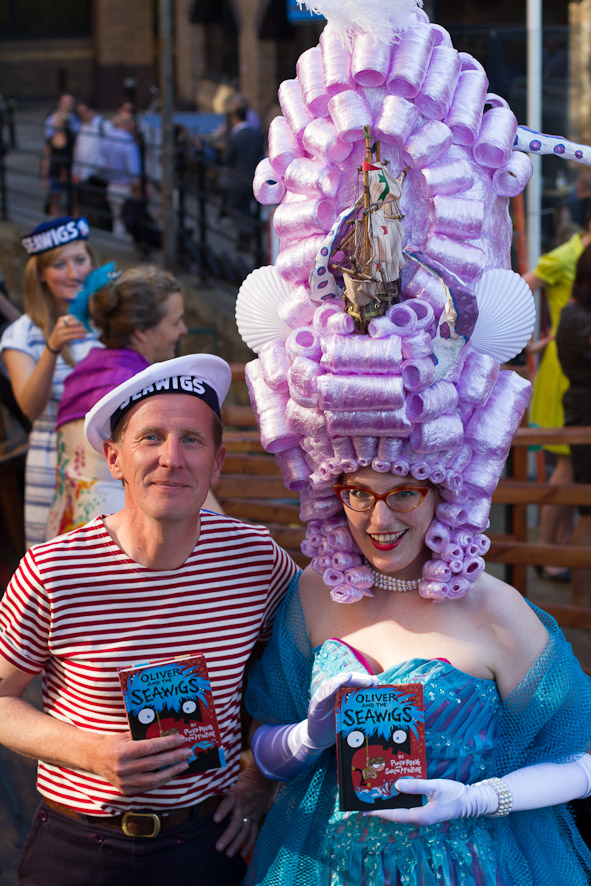
Philip and Sarah at the launch party, Sarah wearing her truly amazing seawig


Sunday, 24 March 2013

Coming Up in 2013: Haunted by William Hussey (and exclusive cover reveal)

Back in January I ran my annual 'Coming Up In...' feature. At the time, Witchfinder author William Hussey expressed an interest in taking part, but he really wanted to wait until the book cover had been finalised by the lovely people at OUP. Naturally, as a lover of William's Witchfinder series, I was desperate to find out more about his new book, Haunted, and so I have been waiting patiently for the moment to arrive. 

And now it is here, and not only do I have the honour of hosting a fantastic guest post by William, but also the very first public reveal of the book cover for Haunted (so remember where you saw it first). It is a little different from most of the YA covers around at the moment, and I totally love it! Rohan Eason's illustrations are so incredibly spooky, and I could stare at the image for hours (and as the book isn't due to be published until September I'm just going to have to make do with this for the next few months). Make sure you click on the pictures to view the images in all their big sized glory.


And now, over to William:


After completing the Witchfinder trilogy, I was really keen for a new storytelling challenge. Witchfinder had been pretty epic: a story that spanned over a quarter of a million words, virtually every monster in the mythical bestiary, and a timeline that started a moment or two after the Big Bang and reached right up to the present day (by way of the Stone Age and the English Civil War!). Now I wanted to write a story with a tighter focus, a tale that concentrated on a few characters over the course of a week.

A week in which a huge, heart-stopping supernatural drama would be played out…

I’m a great believer that writers should always be challenged by their next project. They ought to step into those early pages of a new book with their hearts lodged firmly in their mouths. ‘Can I really do this?’, ‘Am I good enough to pull it off?’ Those questions should forever be ringing in the writer’s mind.

With HAUNTED I set myself two formidable (for me, at least!) challenges. First, I would tell the tale from the point of view of a sixteen-year-old girl. Up until this point, I’d always written my books from a boy’s perspective; could I really capture an authentic voice for a teenage girl? As I got deeper into the story, I began to realise that I shouldn’t always be conscious of the gender of my hero, Emma Rhodes. What did I know about this character? She was clever, strong-willed, determined, resourceful, grieving, robust and yet sensitive, especially to cruelty and injustice. Those were the things that mattered about her, and they were characteristics I admired and felt able to convey.

At this point I should tell you a little about the story:

Emma Rhodes begins the book in a state of complete isolation. Some months ago, her little brother Richie died while in her care. Since that day Emma has been haunted by grief and guilt, a state which has driven her friends away and left her fragile and alone. Into this lonely world comes a mysterious American – a teenager who moves into the derelict Sparrow House across the street. His arrival changes everything. Shrouded in mystery, he begins to draw Emma out of her isolation by revealing to her a shocking truth. Someone in the little town of Milton Lake is using the fabled ‘Ghost Machine’ to call the spirits of the dead back to our world. Now it is up to these two lost souls to find out who is operating this strange invention before it is too late. For call by call, the hungry dead will be unleashed…

My second challenge was to introduce a ‘celebrity historical cameo’ into the book. The Ghost Machine is an antique telephone from the 1920s, its crackling line a pathway to the world of the ravenous dead. But here’s the thing: the Ghost Machine is based on a true story.

Thomas Edison
In 1920 the world-famous inventor Thomas Edison – the man who developed the light bulb, the movie camera, the telephone and the record player – claimed to the world’s press that he was on the verge of inventing a phone for speaking with the dead! No kidding, he really did! After his death ten years later it was thought that Edison had been pulling one of his famous pranks on a bunch of gullible journalists… but what if he’d been telling the truth?

Why would Edison have covered up such a fabulous invention? What might have caused him such mortal terror that he hid the device from the world? And what if the Ghost Machine was still out there, waiting for some desperate soul to start making calls on it again?

Once I’d hit upon the idea of the Ghost Machine in a modern setting (with Emma battling to discover its whereabouts before it tore her world apart), I knew that Thomas Edison himself must feature in the story. What followed is essential for any writer hoping to recreate a historical setting and personality: LOADS of research. I read four HUGE biographies on Edison, as well as several books on the development of early telephones. Once I’d absorbed all my notes, I was ready to write the chapters in which Edison revisited his famous Menlo Park laboratory and, at dead of night, began his experiments with the Ghost Machine.

Research helped to make this ‘character’ seem real to the reader. I had to recreate the way the Great Man spoke, how he moved, how he thought, how he listened (tricky as Edison was almost stone deaf!). I had set myself this challenge before when writing Witchfinder: Gallows at Twilight, which featured the real historical character of Matthew Hopkins, the Witchfinder General. But in that case I was helped by the fact that very little is known about Hopkins, and so I could create the character pretty much as I wanted him. With Edison, I felt a huge amount of pressure to get the real man down on the page as faithfully as I could.

Of course, the real Edison never experienced a night of supernatural terrors, as he does in HAUNTED, but I had to know enough about him as a character – his history, his family, his strengths and prejudices – to make the scene seem as genuine as I could, both for readers who had no clue about the historical Edison and for those who knew his life inside out. It was a terrifying challenge, but one I absolutely relished!

So what more can I tell you about HAUNTED? Well, here are a few teasers: we have a Circle of very unlikely and very ruthless necromancers (or ‘conjurers of the dead’); a haunted house once owned by a mass murderer; a deserted theme park in which a decidedly grisly ghost decides to manifest; a troubled boy with a secret so surprising it will (hopefully!) take your breath away; a hero who faces her grief and terror only to discover one devastating revelation after another; a school library like no other; an antique shop harbouring the most terrifying wonders the world has ever seen; a collector of bric-a-brac who will chill the very marrow of your bones; a mystery that goes to the heart of Emma Rhodes and blurs the line between the worlds of the living and the dead; and a nerve-shredding finale so spooky it made Michael Grant (of GONE fame) lose sleep!

But wait a minute…

Is that a phone ringing in the next room…? No, it’s OK, I’ll wait here.

I think it’s for you

A note on the cover: this is the first EVER reveal of the HAUNTED cover, especially for the brilliant Book Zone. The artist is the very talented Rohan Eason, whose previous work includes The Wolves of Willoughby Chase. What we all wanted from this cover was a very stark fairy tale vibe to go with the gothic spookiness of the story. Lyrical black-and-white imagery contrasting with the red lettering fitted the bill perfectly. I love how the ghosts – or the ‘unmade’ as they are known in HAUNTED – swirl around to frame Emma as she ventures towards the Sparrow House.

A place where many dark secrets wait to be discovered…


Tuesday, 3 April 2012

*** Interview with Tim Bowler

Yesterday I posted a review of the first book in the reissued Blade series by Tim Bowler. Today, as promised, we are joined by Tim who very kindly agreed to answer some questions for readers of The Book Zone.

Hi Tim. Welcome to The Book Zone and thank you for taking the time to answer these questions for us. First up: how would you describe the Blade books to someone discovering them for the first time?

The series is an urban thriller about a fourteen-year-old boy nicknamed Blade and his battle to find redemption for the things he has done in the past. He has a terrifying skill with a knife and he has used this weapon to devastating effect, but he is a victim of the hideous circumstances in which he grew up, and by the time we meet him at the beginning of the story, he is on the run with his enemies closing in. The series highlights his brilliant gifts of survival but also his vulnerability as an individual as he fights against the odds and struggles with his awakening conscience.

What was the original inspiration for the Blade books?

There were several things that inspired the Blade series. Firstly, I have always had a horror of knives as weapons and while I find them frightening in any context, I am particularly horrified by the thought of young people carrying and using them. Secondly, I wanted to know whether someone who has committed the terrible acts of violence that Blade has can possibly come back from that and even have a future. Thirdly, I remember driving through a town in Devon in the 1980s and finding myself at a pedestrian crossing with the light on green and wondering why the car in front of me hadn't started to move forward. When I looked more closely, I saw that a boy of about seven had placed himself on the pedestrian crossing right in front of this other car and was jeering at the driver and daring him to drive on, which of course he couldn't and didn't. Car horns started going off behind me and eventually, when the boy had had his fun and made his point, he sidled over to the pavement with a triumphant grin on his face and 'allowed' the traffic to move on. I forgot about this boy for over twenty years and it was only when I'd written the first scene of Blade, where the seven-year-old Blade is in trouble with the police for holding up traffic at a pedestrian crossing, that I recognised where he had come from.

Blade is a great protagonist. Can you tell us a little more about him?

He's complex, he's dangerous, he's full of contradictions, he's street smart, he's bright, he loves books, he has an inquiring mind, he's inventive with words, he's likable, he's courageous. He's also deeply damaged. He's been damaged since the day he was born and it wasn't till he was ten that he started to learn to love and to trust. But by then it was too late and when he fled from his enemies at the age of eleven to go to ground in a new city, he sealed his mind against the possibility of ever loving or trusting again. But he didn't seal it tightly enough.

When the Blade books arrived at the school library a few years ago my librarian was a little hesitant about putting them on the shelves because of their focus on knife crime. I managed to persuade her that they were fine for our students. Have parents, teachers or librarians expressed similar concerns to you? What would your answer be?

One librarian did say to me that she was worried the series might glamorise knives for young people, but she hadn't read the books. I suggested that she first of all read the books for herself, and then find me one paragraph, one sentence even, that glorifies knives or suggests they're a good thing. Within just a few pages of the first book, we realise that this boy has a life nobody would want, and things only get harder for him as the story progresses. Far from portraying the romanticised life of some devil-may-care teen buccaneer with swashbuckling knife skills, the story shows a boy haunted by fear and guilt and perpetually on the edge of death, a boy fighting not just to save his own life but to believe in the point of that life. Blade is not a preachy story but it is a deeply moral one and I fail to see how an urban odyssey of this kind with sympathetic character portrayals and fast-moving action can possibly damage student readers, provided they are willing to embrace its issues in a mature way.

I have loved reading books ever since I was a child. Were you like this when you were younger or were you a reluctant reader? Who encouraged you to read when you were younger?

I'm just like you: an avid reader. I started at the age of five and never stopped. I just dived into reading. The first story I read was a sea story (Little Tim and the Brave Sea Captain by Edward Ardizzone) and I've been passionate about sea stories ever since: Arthur Ransome, C.S. Forester, Patrick O'Brian, Robert Louis Stevenson etc. I lapped them all up. I also loved Tintin books, which I read in French, and thriller writers – too many to name – and then in my late teens I started moving towards poetry too. Since my twenties I've read pretty much anything that interests me – fiction of all kinds, poetry, non-fiction, e.g. biographies, history, history of music, diaries, letters, philosophy etc.

Is there anything else you would like to say to readers of this blog?

Just that it's been a real pleasure talking to you and to wish you all well. Thanks for your interest in Blade.

~~~

Huge thanks to Tim for taking the time to answer these questions, especially as I know he has been very busy recently. If you have not yet discovered the Blade series then the books are perfect for teens who love realistic, gritty thrillers. You can find out more about Tim and his many books at his website http://www.timbowler.co.uk/ 

Monday, 2 April 2012

Review: Enemies by Tim Bowler (Blade book one)


Meet Blade. But be careful. You might not like what you see. He's dangerous. He needs to be. Because there are people who want him dead.

It's dog eat dog in his world. Win or die. He thought he was safe. But now they've found out where he is. And they're coming.


Tim Bowler's Blade books have been around for a handful of years. The first book, Playing Dead, was first published back in 2008, followed by a further seven instalments over the next couple of years. I remember Playing Dead arriving in the school library - my librarian stopped me as I was passing through and, concerned about its early mention of knife crime, asked me if was suitable to be put on the shelves. I had a very quick read of the opening chapter and gave her the thumbs up but for some reason I never got around to reading it fully at the time. Now Oxford University Press have started to reissue the books, this time over four volumes, and they very kindly sent me a copy of the first, Enemies, to read and review. 

All I can say is that I am disappointed that I did not continue to read Playing Dead back in 2008 as I would have spent the last four years recommending them to any teen reluctant reader who said they liked thrillers. If there was a checklist of elements that were guaranteed to suck a teen boy into a story this book would have a tick in every single box: a great protagonist that teens will easily identify with; a fast, very tightly plotted storyline; short chapters, most of which end in a way that pretty much force you to carry on reading; a very modern theme of youth crime, and how for some things can spiral out of control. Instead of closing libraries the government should be pulling disaffected kids into them and placing books like this into their hands.

The story is narrated by Blade, a fourteen year old with a a great deal of secrets in his past. As such, we know very little about Blade other than what he chooses to reveal as the story progresses, and herein lies the real magic of this story. Blade is such a believable character that even though I was a rather well behaved teenager, and many years ago to boot, I still found myself identifying with him, caring about him and fearing for him. I very quickly found myself desperately wanting needing to know the back story behind this damaged young man. Why is he on the run? Who are the thugs hunting him down? How has he survived living alone on the streets for so long?

Blade's narration of the story is quite different from most books I have read in recent years. As a reader I really felt that Blade was talking to me personally, such is Tim Bowler's mastery of the first person narrative. Blade even goes so far as to refer to the reader as Bigeyes, as if he was telling his story out loud across a Big Mac and fries. He also uses a great deal of street talk and colloquialisms, which again will appeal to teen readers.

This book would make a great class reader for a group of lower ability teens as it would engage them, and also draw them into discussions about Blade's behaviour, his use of language, and the general themes of teen crime and homelessness. It is certainly one I will be recommending to the English teachers at my school.

Enemies was published back at the beginning of February, and the sequel, Flight, is due to be in shops in June. I feel though that I must reiterate that these are reissues of books that were earlier published with different titles so please double check before buying. Please come back tomorrow when I will be posting an short interview that Tim has very kindly done for The Book Zone.


Thursday, 12 January 2012

15 Days Without A Head Blog Tour - Guest Post by Dave Cousins

I first heard about Dave Cousins' debut YA novel, 15 Days Without A Head, at a bloggers' event heald by OUP back in 2011. Dave treated us to an reading of one of the many laugh-out-loud funny scenes from his book, which tells a story that is poignant, heart-warming and hilarious in equal measures. To celebrate the publication of the book on 5th January Dave has embarked on a ten-stop blog tour, and I am really chuffed to be hosting him today.

~~~

My Dream Holiday by Dave Cousins 

In 15 Days Without a Head, Laurence attempts to win an all-expenses-paid holiday of a lifetime courtesy of local travel company, Hardacre Holidaze. Readers sometimes ask what my dream holiday would be like …


The Hardacre Holidaze brochure arrived on a wet Wednesday morning. It slipped through the letterbox like a glossy paving slab and slammed onto the mat. Fortunately the cat wasn’t occupying the spot at the time, but the sound woke me up.

Not just a holiday, the best daze of your life, read the slogan above the photo of the beautifully bronzed family on a golden beach – so far removed from my icy attic, they might as well have been on the moon. I didn’t remember ordering the brochure; I wasn’t sure I had time for a holiday. But I opened it anyway – it couldn’t hurt to dream.

It might have been my imagination, but I was sure I could smell something wafting up from the pages; had the printer imbued the ink with the essence of holiday perhaps? The way fashion magazines offer tear-off perfume samples, or supermarkets pump out the smell of baked bread to make you hungry.

I flicked through the slick pages of silver sand and azure seas, and felt vaguely nauseas. I’m not a huge fan of the heat – my Celtic blood is better suited to cooler climates, I suspect. A beach holiday wasn’t what I wanted – somewhere in the mountains maybe, or a city. I’d always liked the idea of New York in Winter, when it snows … And then I saw it: a black and white half-page advert towards the back of the brochure. It looked out of place – squeezed in as an after-thought.

Your Dream Holiday! I read. Dream it and you’re there! No early check-in queues; no rough sea-crossing; no sweaty hours in the car – you won’t even need to leave your bed. Just take our special pill and close your eyes. Anywhere, anytime, anyplace. If you can dream it – you can go!


Two days later the sunburst yellow tablet rested in my palm. I hadn’t really expected it to arrive; hadn’t thought I’d actually take it. But then it seemed a waste not to. New York in the snow – if you can dream it, you can go!

It should have occurred to me that I might just as easily end up in a nightmare. The dream holiday equivalent of arriving to find that your hotel is a building site, or that enjoying your sea view requires binoculars and an intricate arrangement of mirrors. The big difference was – I couldn’t just get the next plane home. My luggage, along with my RETURN pill, was on its way to New York. All I had were the pyjamas I was wearing, the Hardacre Holidaze brochure and the cat – who must have sneaked onto the bed as I fell asleep and found himself on holiday, by mistake.

In hindsight, the bedtime snack of cheese on toast probably hadn’t been a good idea. I remembered something in the instructions that arrived with the tablet, about foods best avoided. It must have been the cheese. What other explanation was there for the fact that I was now walking along a seafront made entirely of Camembert? The cat didn’t seem to mind, and was quite happily sniffing and licking his way along the promenade. But as the twin suns climbed higher in the purple polka dot sky, the cheese began to melt and I was soon up to my knees, the cat beside me, riding the Hardacre Holidaze brochure like a surfboard. We had to find a way home before we were both turned into fondue.

The cheese was up to my waist when I glimpsed salvation – a red post box, rising up out of the yellow sea like a lighthouse perched on a rocky outcrop of Wensleydale. By the time I hauled us from the cheesy slop, the cat was hallucinating from an overdose of lactose. I extracted the holiday brochure from his claws and wiped the cheese from its glossy laminated cover. It was a relief to see our address still legible on the label. A plan was forming in the back of my mind, a plan that unfortunately involved climbing all the way to the mail slot, high above our heads.

Luckily the post box was made from bricks, the gaps between providing hand and foot holds, but it was a slow and dangerous climb, particularly with a twitching cat tucked inside my pyjama top. It was the longest night of my life. With the darkness came a storm, an angry sea clawing at us from below while grated cheddar rained down from the sky. We finally reached our destination as dawn broke above the distant Edam mountains, and with my last gasp of strength, I dropped the brochure into the slot and fell … backwards into space.


The snap of the letterbox and the sound of something heavy landing on the mat woke me. I sat up, surprised to find the cat inside my pyjama top and grated cheese in my pocket. Then I remembered the cheese on toast I’d eaten late the previous evening. That might explain the strange dream I’d been having – though the moment I tried to recall any details, it vanished. I removed the cat from my nightwear and went downstairs to see what the post had brought.

I didn’t remember ordering the Hardacre Holidaze brochure; I wasn’t sure I had time for a holiday. But I opened it anyway – it couldn’t hurt to dream …

~~~

My huge thanks to Dave for taking the time to write this brilliant piece for The Book Zone. Watch this space for my review of 15 Days Without A Head coming soon.

Wednesday, 11 January 2012

Review: Mortal Chaos by Matt Dickinson


Some will live. Many will die. All are connected.

'The Butterfly Effect ': the scientific theory that a single occurrence, no matter how small, can change the course of the universe forever. When a butterfly startles a young rabbit, and the rabbit makes a horse rear, it starts a chain of events, over the course of one day, that will change people's lives . . . and end people's lives. From a climber on Everest to a boy in Malawi . . . from a commercial pilot to an American psycho . . . the chaos knows no bounds.

Some time ago I was fortunate to be invited to an event for bloggers held by the good people at OUP. The purpose of the event was to introduce us to two of their authors, Joss Stirling and Dave Cousins. During the event we were each given a copy of another of their 2012 releases, Mortal Chaos by Matt Dickinson. They spoke about this book with great excitement, assuring me it would be like no other book I had ever read. I finally got around to reading it two nights ago, and I have to admit that they weren't wrong.

This is Matt Dickinson's first book for the YA market, although I gather that he is the author of several action/adventure book for adults. I'm not sure what I expected from Mortal Chaos, perhaps some kind of hi-octane action story, but what I got was something very different indeed. In fact, I am struggling to think of how I can describe it.

The premise of Mortal Chaos centres around an aspect of chaos theory known as the butterfly effect. This concept suggests that a small, seemingly minor incident can result in a major incident elsewhere. The usual example given is that of how the fluttering of a butterfly's wings could create ripples that eventually lead to a hurricane forming somewhere in the world. Matt Dickinson's story starts off with this infamous butterfly, but the consequences in this case have little to do with a hurricane, but are potentially as destructive as far as the lives of a number of disparate characters are concerned.

The characters in question range from a pair of boys bunking off school to go hunting in the local woods, to a female airline pilot, to a six year old African boy, to a teenage climbing prodigy on an ascent of Everest, to an american guy with his heart set on mass-murder. On the face of things their lives have absolutely nothing in common, and on any normal day their destinies would be completely unconnected. However, that darn butterfly changes this state of affairs with extreme consequences for some of them.

This book is only 286 pages long, and the sometimes only half-a-page chapters jump between the multitude of different characters as the day-in-their-life unfolds. It hooked me from the first few pages; so much so that before I knew it I was more than half way through and then just couldn't go to sleep before I had finished it. With so many characters gradually being introduced I initially thought that I would struggle to develop empathy for any of them, but the author manages to make you care about their various fates without you even realising he is doing it. The publisher's blurb states that "Some will live. Many will die. All are connected" and part of the appeal, and the moments of extreme tension I felt whilst reading it, was in trying to work out just who would or would not survive by the end of the book.

I will definitely be ordering this one for the school library as I think many boys will find its short chapters and fast paced stories as addictive as I did. I assumed that this book was a one-off, but in searching for the blurb to include at the beginning of this post I have discovered that Matt Dickinson has another book scheduled for publication in July. It does not appear to be a sequel as such, more a brand new series of stories based on the same butterfly effect theory. The details of Mortal Chaos: Deep Oblivion read as follows:

Hannah, homeless and on the run. Gwen and Tehpoe, kidnapped by violent rebels. Todd and Isabella, threatened by piranha attack. Wai Yan, hunted by a cruel dictator. Stian Olberg, fighting to save his vessel from imminent destruction. For them, and many others, things will never be the same again. Some will live. Many will die. All are connected.

Something worth waiting for I feel, if its predecessor is anything to go by.


Friday, 4 February 2011

Review: Buried Thunder by Tim Bowler


When Maya strays into the forest, she walks straight into a nightmare.

It’s not just the horrific discovery she makes among the trees, it’s what’s waiting for her at home. Something too terrifying to believe in. She’s not even sure she believes it herself.

Perhaps she’s going mad—only imagining the sounds in the night and the feeling of being stalked. Maybe she didn’t see anything in the forest after all?

And there’s another question: what was she doing there in the first place . . . alone . . . at dusk? All she knows is that the eyes of a fox drew her there.

They will do so again.

Love horror? Getting a bit fed up with vampires, werewolves, zombies and the blood and gore their stories often contain? Well 2011 could be the year for you then, as there are a number of more traditional haunted house, ghost and psychological horror stories on the horizon. I have already featured Cliff McNish telling us about his forthcoming title The Hunting Ground, and I have just finished reading an early proof of a totally spinechilling book called Long Lankin by Lindsey Barraclough. But the first chiller I read this year, which is also the first of these to be released, was Buried Thunder by the brilliant Tim Bowler, officially published by OUP on today.

Tim Bowler is a name that should be up there with the likes of Darren Shan, William Hussey and Charlie Higson, but for some unknown reason he has yet to make the leap to stella stardom that these other horror authors have made. Maybe it is because his books are so different from these, very much relying on the psychological aspects of the horror story; the kind of stuff that made Stephen King such a successful author. I think many young people today have a view that horror equals blood and guts, or one of those aforementioned classic monster types, and therefore view books like Buried Thunder as thrillers instead. However, many of the more popular adult horror authors such as King and James Herbert have built their careers on just this kind of writing. Like these authors, instead of gore Tim Bowler fills his stories with atmosphere, and in doing so creates a feeling of creeping dread within the reader from the very first page, a dread that lasts well beyond the end of the story.

However you label Buried Thunder, be it horror or psychological thriller, it is still pretty damn unsettling. It tells the story of Maya, a fourteen year old girl who has just moved to the countryside with her parents and brother, as they start their new life running a small hotel. Tim Bowler doesn't waste any time introducing characters or back story, instead on the very first page he has Maya stumbling across several bodies in the local woods, bodies that there are no sign of later when the police begin their search of the area. Even worse, one of the investigating police constables is the spitting image of one of these bodies. 

Immediately our minds and filled with questions: Is Maya going mad? Has she had some kind of premonition? These questions and more play on the mind all the way through the book, and just as it seems an answer is looming and the evil machinations of a particular character revealed, Tim Bowler adds a deft twist to the plot and someone/something else comes under suspicion. And what's more - not all of these questions are answered come the end of the story and the author leaves the reader to come to their own conclusions regarding the meaning behind some of the more supernatural elements of the story. I know some readers will not like this but I thought it was inspired - it left me thinking about the book for some time after. Add to this mix a handful of rather strange and sinister characters, animal mutilations, and scratching noises at Maya's bedroom door during the night and you can't help but fear that the ending may not be a good one for Maya or her family. And as with some of Tim Bowler's previous books there are strong mystical elements to this story which keep the reader hooked from the very offset, desperate to discover just what the hell is going on.

As I was reading this book I couldn't help but think about some of the classic serials that the BBC used to show in their 4-6pm slots back in the 1970s and 1980s, some of which were adaptations of books. I'm thinking serials such as The Owl Service, Moondial, Children of the Stones, and many others that I enjoyed at the time but for the life of me cannot remember the titles of now. Buried Thunder is very similar in nature to these old school stories, some of which were very scary at the time, although not having watched children's TV for some time I have no idea if dramas like this are made these days.


I have not read many of Tim Bowler's books but Buried Thunder has certainly made me want to hunt more of these out. If you want more information about his work then why not do as I did and pop over to his website at http://www.timbowler.co.uk where, with a little hunting, you will also be able to find a short video clip of Tim reading an extract from Buried Thunder. My thanks go to Michelle Harrison at OUP for sending me a copy of this book.


Thursday, 6 January 2011

Review: Witchfinder - Gallows At Twilight by William Hussey


Eight pale hands - some with fingers stripped down to the bone - rose out of the earth. Slimy with rain, the rat-gnawed heads of four soldiers loomed into view. They moaned at the sky and their cry moulded itself into a word: 'FLLLLLLEEESSSSSSSSHHHHH!' The Demon Father has escaped from hell and walks among us, his trident symbol branded into the earth in countries all over the world. A scorching beacon. A call to arms. A sign that war is coming. Jake is struggling to harness his powers and live up to his reputation of the boy who closed the demon door. But now he must push all doubt aside. To stop the Demon Father Jake must change the course of history - embark on a treacherous journey deep into the past and into another dimension, filled with horror and pain. A place where innocent people are tried and tortured. A place where the law of the Witchfinder rules. Let the rushes be lit for there will be gallows at twilight.

Witchfinder: Dawn of the Demontide was one of my favourite books of 2010; it was the Book Zone Book of the Month for March, and was instrumental in awakening in me a love of horror fiction that had lain dormant for most of my life. Needless to say, I have been waiting impatiently for this book to be released for almost a year. I was therefore really excited when someone at Oxford emailed me asking if I would like a pdf version of the book, and I jumped at the chance as I had recently bought myself a Kindle.

Was the wait worth it? Yes.... every single second of it. Dawn of the Demontide was a very good book, but this is what I would call a great book. It is The Empire Strikes Back to Dawn's Star Wars in pretty much every way. The story is far darker than the original, taking reluctant hero Jake Harker to places that no sane person would willingly choose to venture into; it is more complicated that the original, with the action taking place in the modern day (both our world and the borderland world between ours and the worlds of the dark creatures), and also in the 17th Century; and like in Empire you have that constant feeling that this time maybe things won't turn out ok for the good guys at the end of the story. With the introductions all having been taken care of in the first book Mr Hussey is also able to spend more time fleshing out his characters even more, so when bad things happen to them (and believe me, bad doesn't come close), we really feel their pain. Add to this that Jake discovers that the girl he loves is seeing his best friend and I think the parallels are almost complete, although this is very much a horror story.

For me the highlight of this book was William Hussey's genius decision to take Jake back in time to 1645. Now I know some of you may let slip a small groan of dismay or ennui at the thought of yet another time travel plot line, but bear with me, for this author does it in a way that fits perfectly with what has come before, and the story he still has to tell in this book. Jake's father has been grievously injured, and Jake is led to believe that the only item that can save him from death is Josiah Hobarron's witch ball, last seen falling from the old witchfinder's hand as he sealed the Door back in the 17th Century. With Crowden alive and well and gathering witches from all over the world and Tobias Quilp rescued from imprisonment beneath the Hobarron Institute, Jake decides that he has only one option - to take the Scarab Path and travel back through time. Unfortunately nobody thought to explain to Jake that appearing out of thin air, engulfed in a magical fire and firing explosive ball of light from his hands was probably not the best method of arriving in a time period famous for its witch trials and the anti-witch paranoia that was prevalent in many areas. Oops!

Anyway, where was I.. oh yes, Hussey's genius decision, etc. Taking Jake back to 1645 has enabled the author to use as a key character one of the nastiest men that ever existed - Matthew Hopkins (aka the Witchfinder General). A real historical person such as Hopkins is a gift to any horror author - who needs to spend time creating a truly evil and despicable character when real life can be so much more scary and nasty? Jake's problems are compounded by the fact that Hopkins also has a grudge to settle with Josiah Hobarron, and being cloned from the DNA of the original witchfinder means that Jake is the spitting image of Hopkins's nemesis. Oops again. So begins a section of the book which is not a comfortable read at times as Jake is proclaimed to be a witch and tortured for his confession. And again, this is made all the more horrific by the fact that the torture of innocent people in this way really did happen. Now I am no expert historian, but I am guessing from the descriptions of the time, its people and everything else that happens, that this is a time period that William Hussey knows well, and has been fascinated by for some time.

Hussey manages the time travel aspects of this book far better than many others who have tried and failed. He also introduces a clever plot device by which Jake's friends in the 21st Century are able to follow, albeit intermittently, his progress (or lack of it) back in the past. Unfortunately for Jake he is very much on his own, striving to reach his goal but never knowing if he will be able to return to his own time and if, should he manage it, he will be in time to save his father and the world. It is these moments in the past in which Hussey really shows his great ability at character development as we witness the gamut of emotions that Jake experiences, from despair to anger to love for a girl he doesn't know, or does he?

And if all that this isn't enough to sate your hunger for the horrific then there is more: English civil war solder zombies; cannibalistic witches; a super-coven gathering at Wembley Stadium; and probably nastiest of all - the Khepra Beetle. I will not say any more about this creature at the moment, but believe me when I say that a headache will never seem the same again after reading about this little monster.

Witchfinder: Gallows at Twilight is officially published today but if you have not yet read the first book then you really should as this is a series that must be read in order. Book three in the trilogy, The Last Nightfall, is scheduled for a September 2011 release, and if you have seen the cover you will know that things are probably going to get worse for Jake and his friends before they get better.